
Selling or buying a vehicle in Indiana? Indiana began offering electronic title options in July 2025 — but for most standard private party sales, the signed paper title remains the primary ownership document.
This free template is formatted for Indiana’s requirements and works alongside the Certificate of Title and State Form 205 at a BMV branch or BMV Connect kiosk.
Click Get This Template below to open it in Google Docs, then click Use Template to save a copy to your Drive.
For templates for all 50 states, visit the Motor Vehicle Bill of Sale Templates →
On this page:
- What Is an Indiana Motor Vehicle Bill of Sale?
- Is a Bill of Sale Required in Indiana?
- Indiana-Specific Requirements
- Free Indiana Motor Vehicle Bill of Sale Template
- How to Fill Out the Template
- How to Transfer a Car Title in Indiana
- Frequently Asked Questions
What Is an Indiana Motor Vehicle Bill of Sale?
An Indiana motor vehicle bill of sale is a written record of a private vehicle sale.
In Indiana, a bill of sale is used primarily when the Certificate of Title is not available or not required — for example, for vehicles that do not need to be titled under state law. For most standard private party sales, the signed Certificate of Title is the primary ownership document.
Is a Bill of Sale Required in Indiana?
Indiana’s BMV requires a bill of sale primarily when the Certificate of Title is not available. For out-of-state title transfers, a bill of sale or purchase order is required alongside the title application.
Even when not required, a bill of sale is strongly recommended for all private party sales — it documents the purchase price, protects both parties, and is useful if a dispute arises.
Indiana-Specific Requirements
1. 45-Day Deadline
The buyer has 45 days from the date of purchase to apply for a new Indiana Certificate of Title at a BMV branch or BMV Connect kiosk. Penalties apply after 45 days.
2. Electronic Title Option (July 2025)
Effective July 1, 2025, Indiana now offers customers the option to have their titles issued electronically or on paper. For dealer-to-dealer transfers, authorized dealers can process electronic title transfers without requiring a paper title from the seller.
For most standard private party sales, the paper title process remains the norm.
3. What the Buyer Must Bring
- Signed Indiana Certificate of Title (properly released by seller and lienholder if applicable)
- Completed Application for Certificate of Title (State Form 205)
- This Bill of Sale or purchase order
- Odometer Disclosure Statement (State Form 43230, if not on the title)
- Valid Indiana driver’s license or ID
- Proof of Indiana liability insurance
- Payment for title fee and applicable sales tax
4. Sales Tax
Indiana charges sales tax on private vehicle purchases. If the buyer paid sales tax to another state, Indiana gives credit for the amount paid — if it is less than Indiana’s rate, the difference is due at time of title. New Indiana residents are not charged sales tax when transferring a title from their prior state of residence.
5. Odometer Disclosure
Odometer disclosure is required for vehicles under 10 model years old with a GVWR of 16,000 lbs. or less. The disclosure must be completed on the title or on State Form 43230. Trailers, vehicles over 16,000 lbs., and watercraft are exempt.
6. Notarization
Indiana does not require notarization for a standard private party vehicle bill of sale. Notarization is optional but recommended for high-value sales.
Free Indiana Motor Vehicle Bill of Sale Template
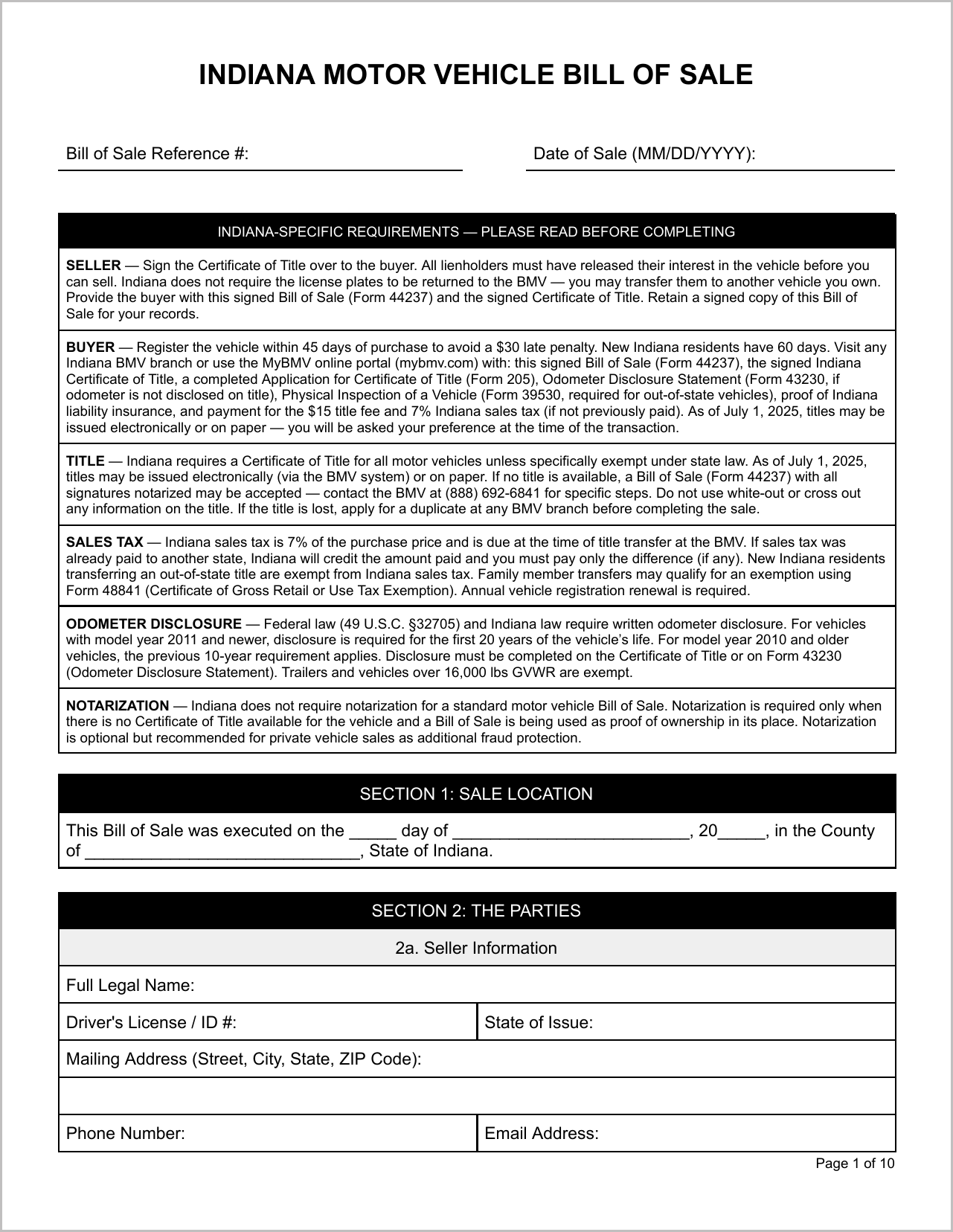
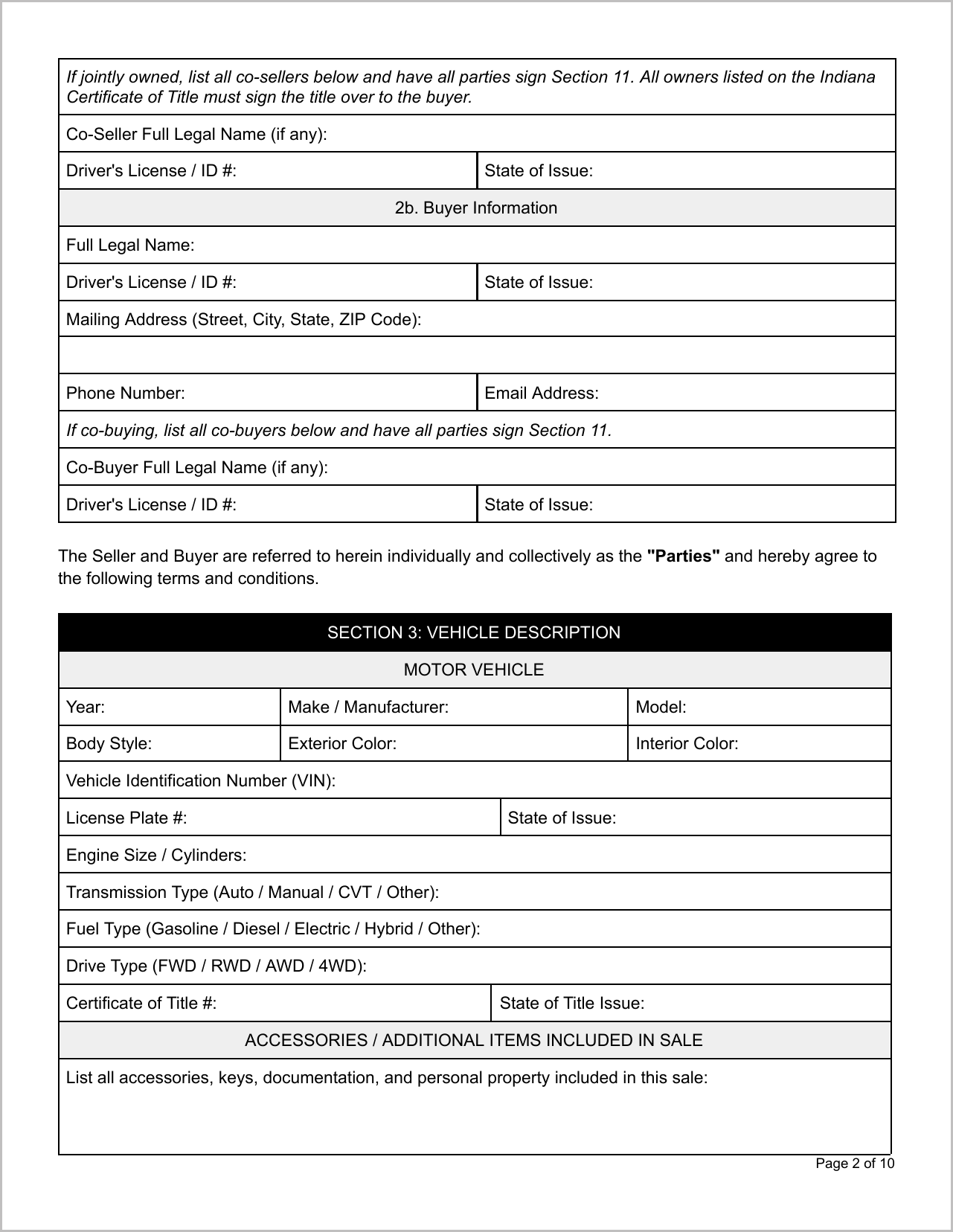
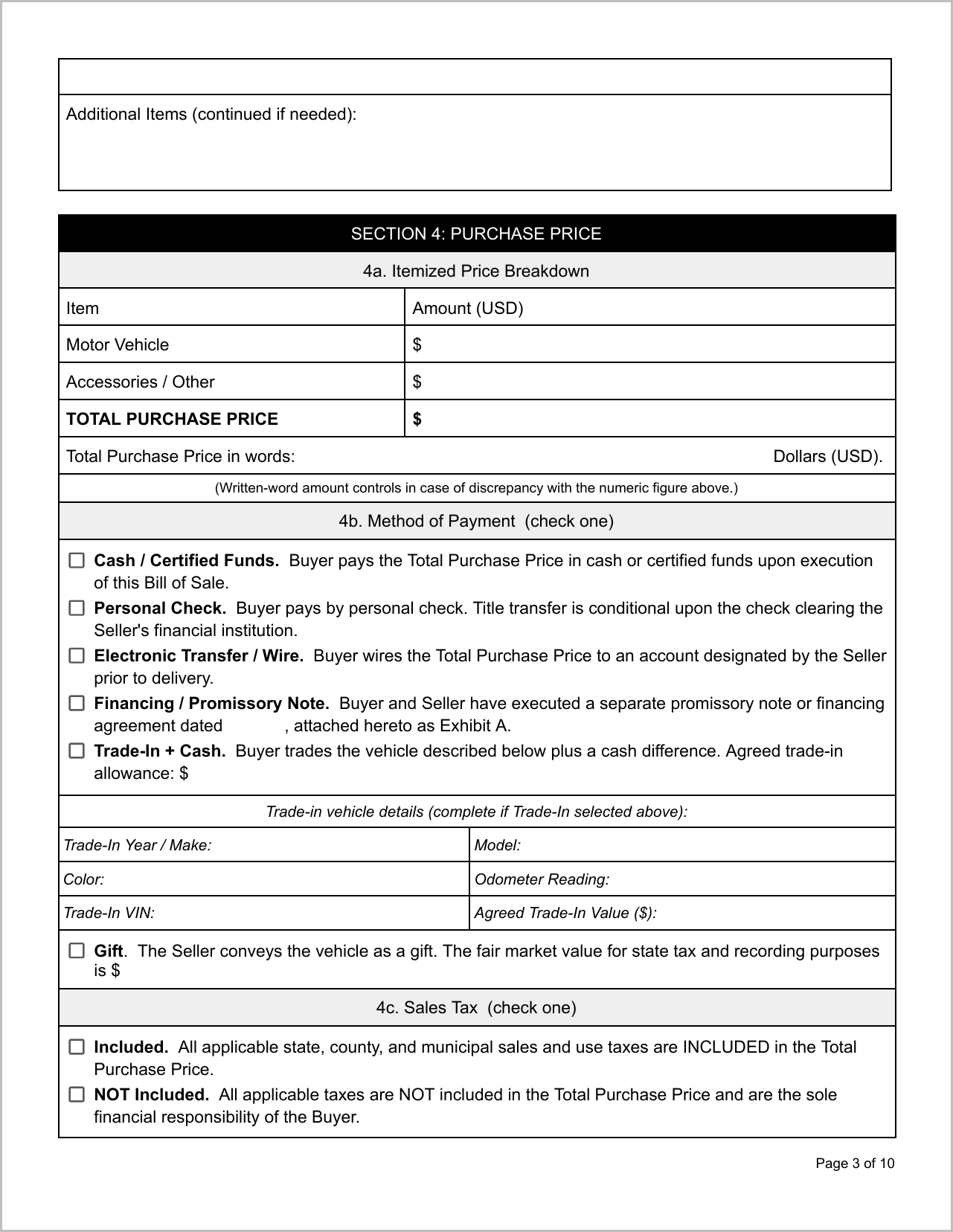
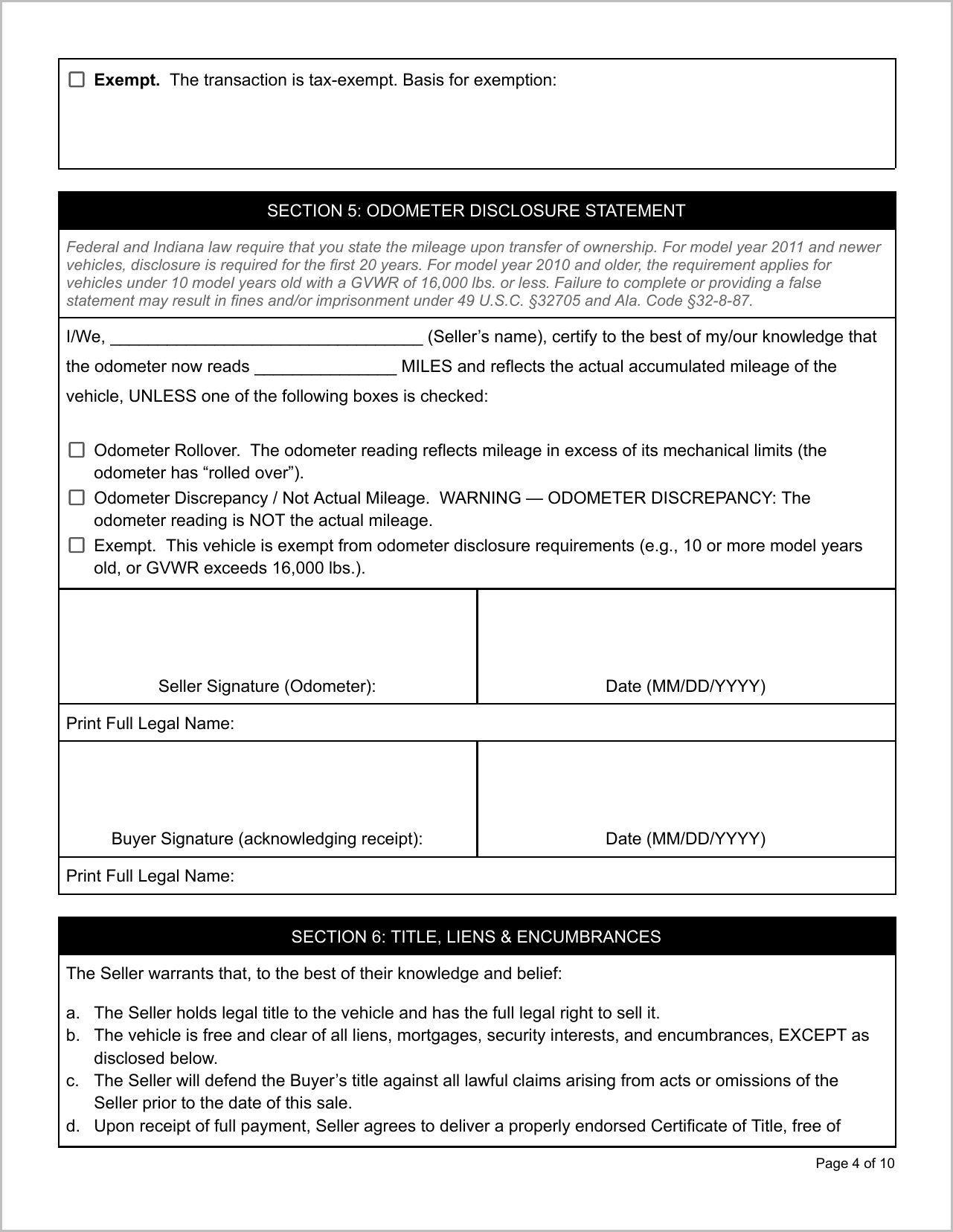
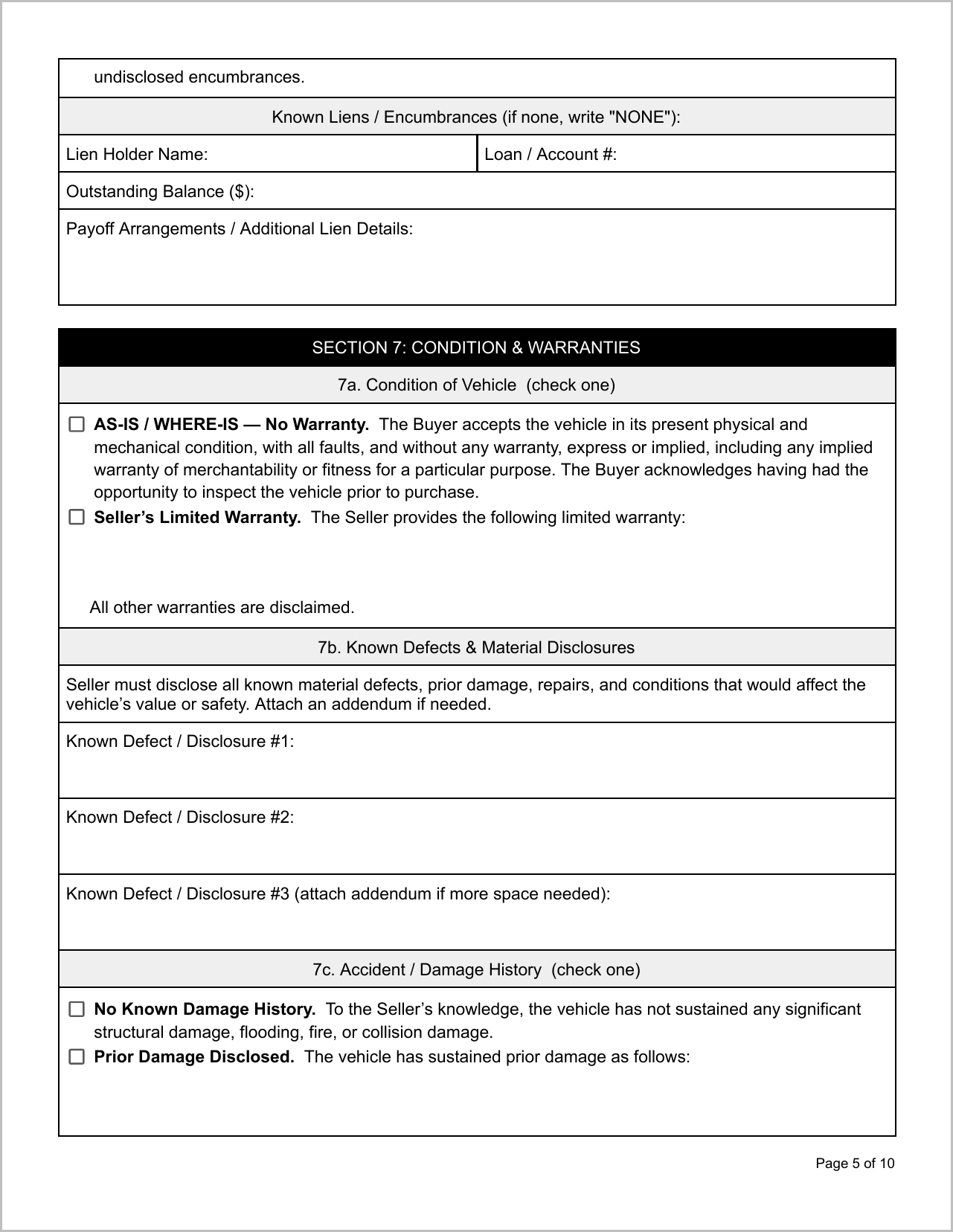
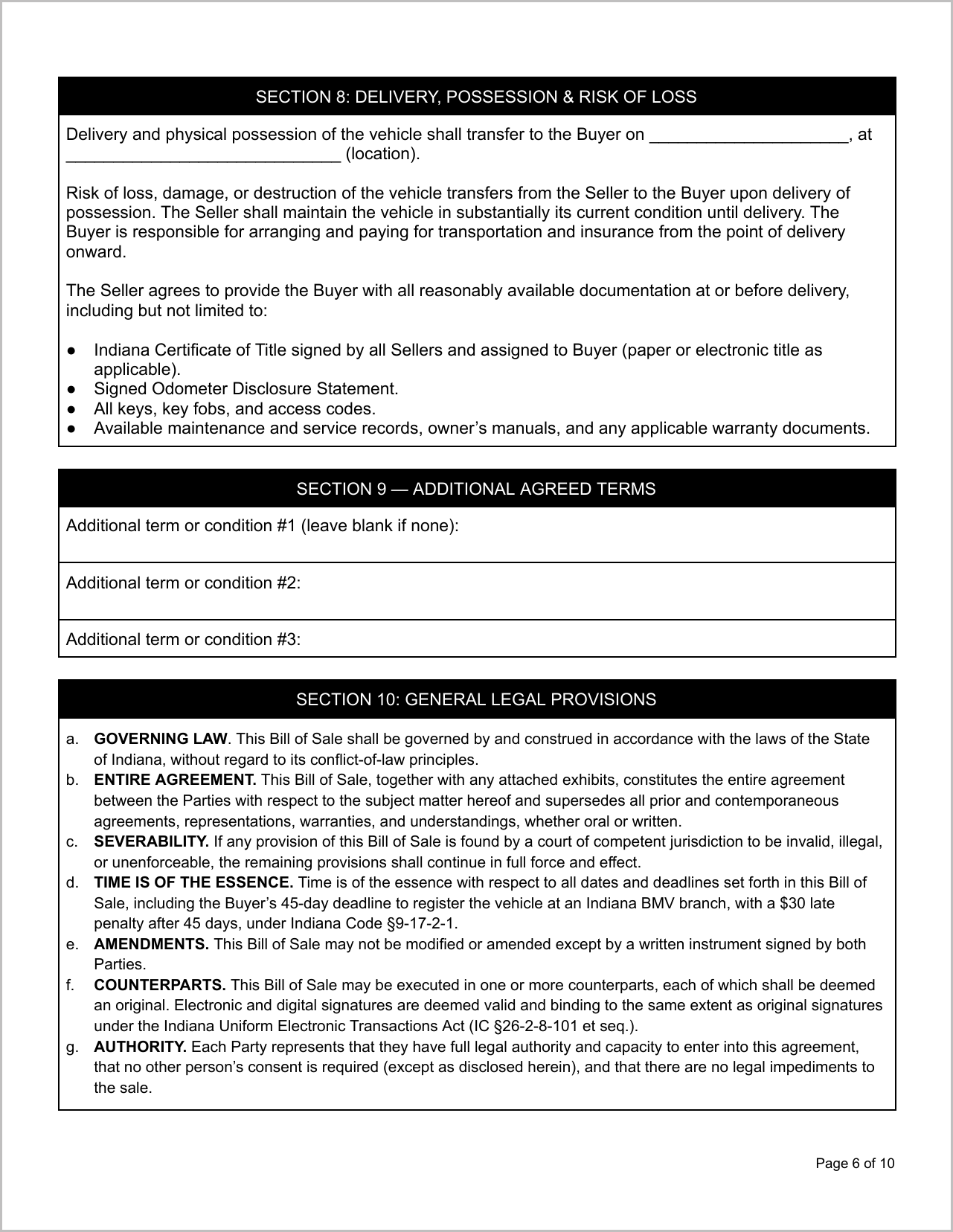
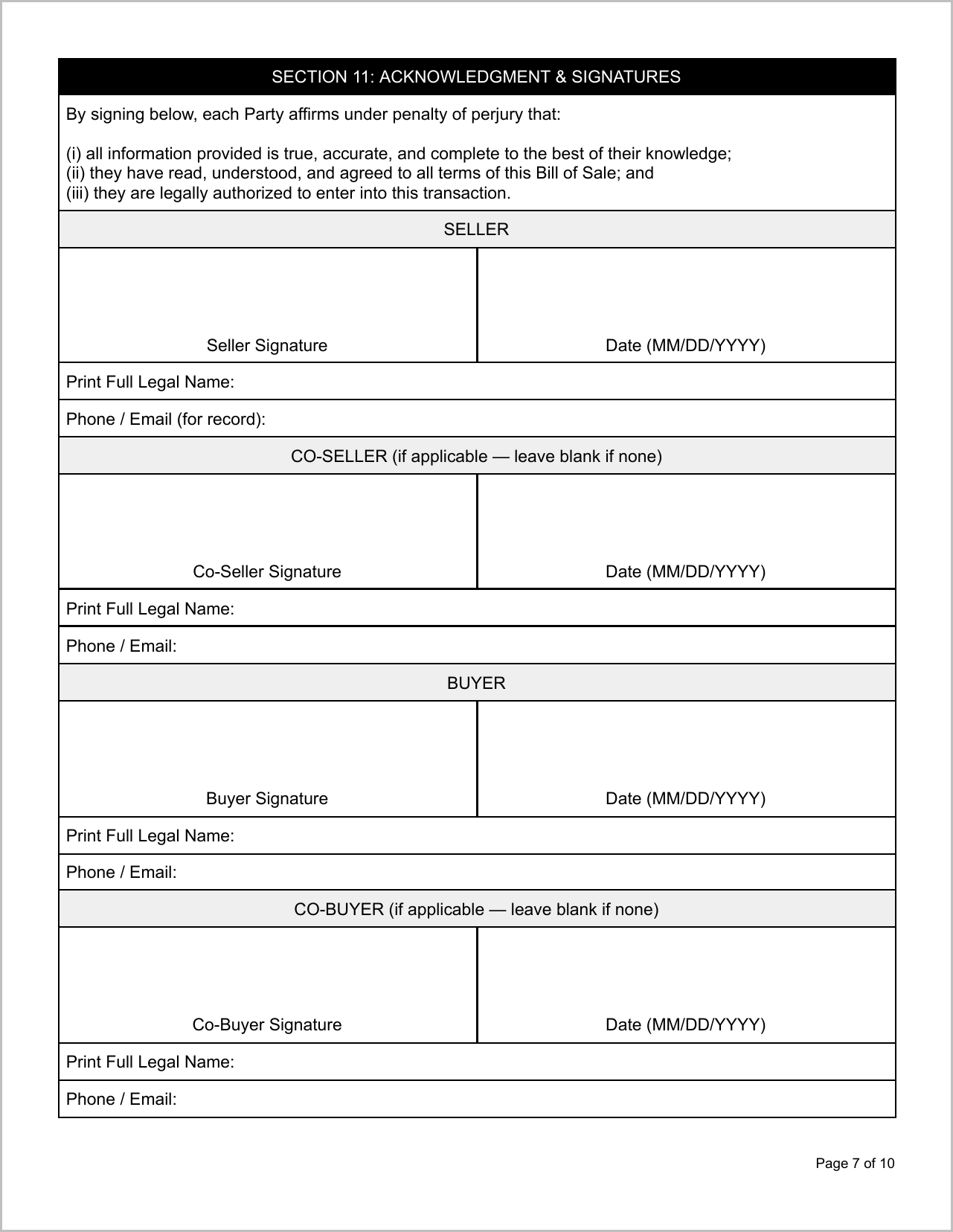
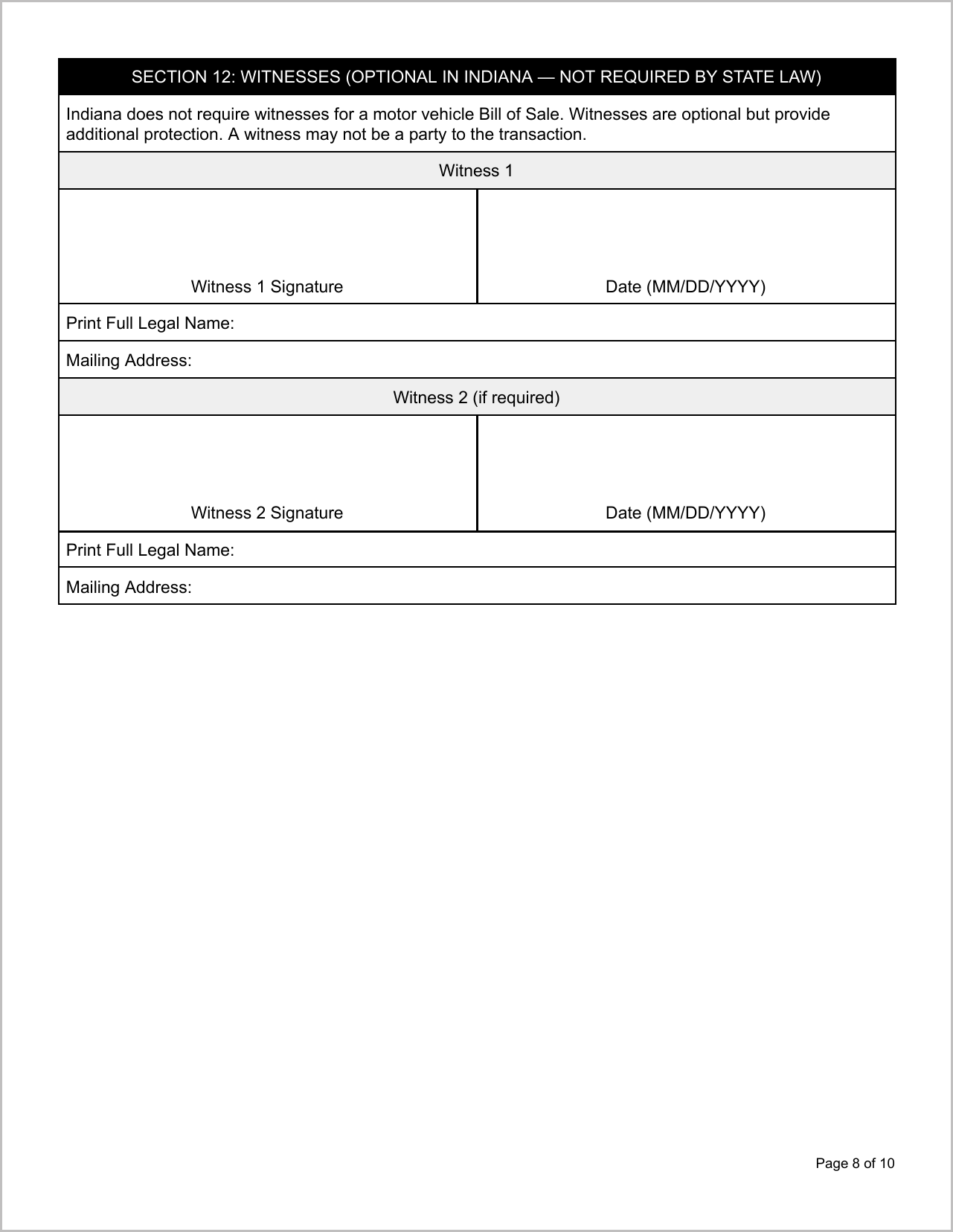
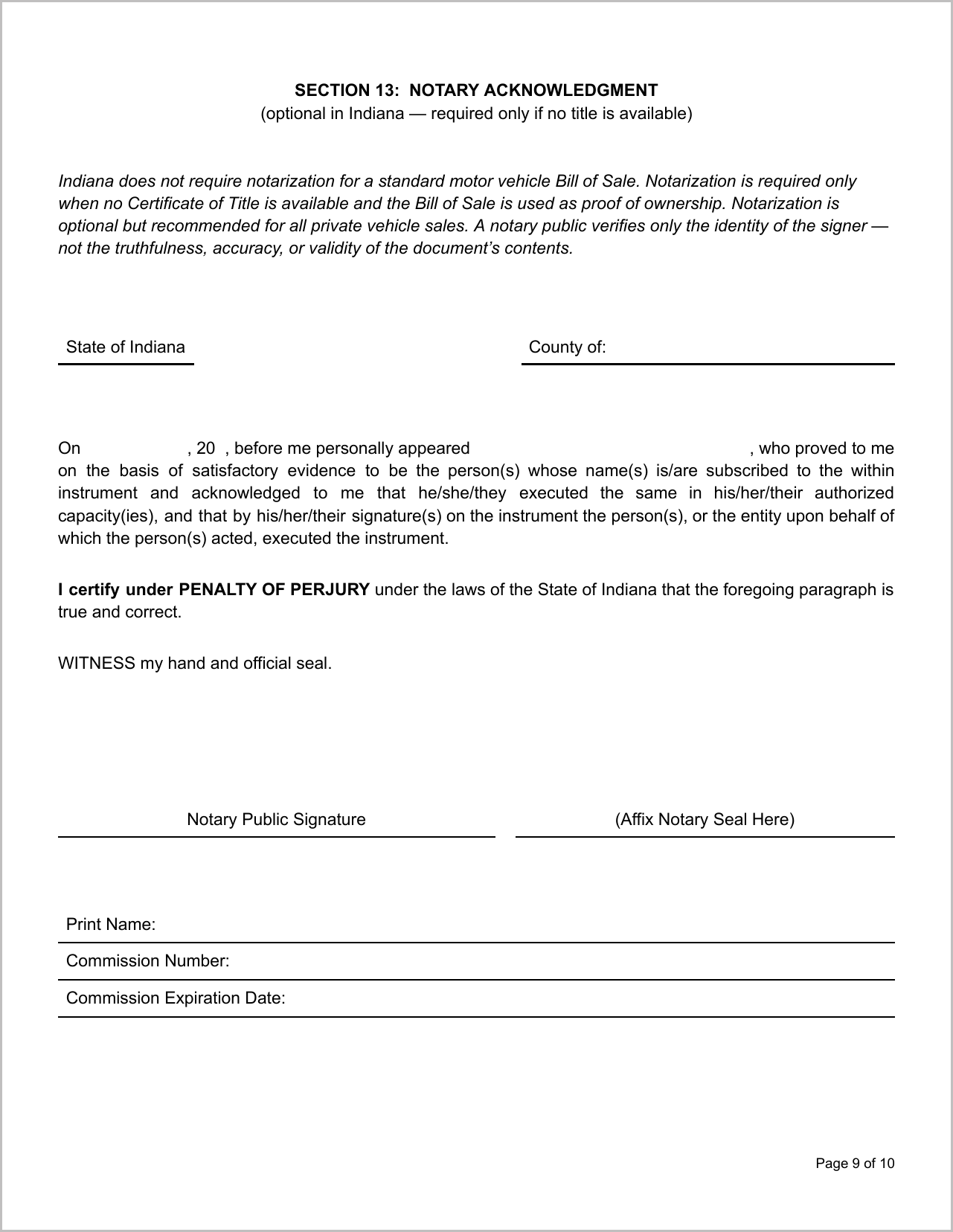
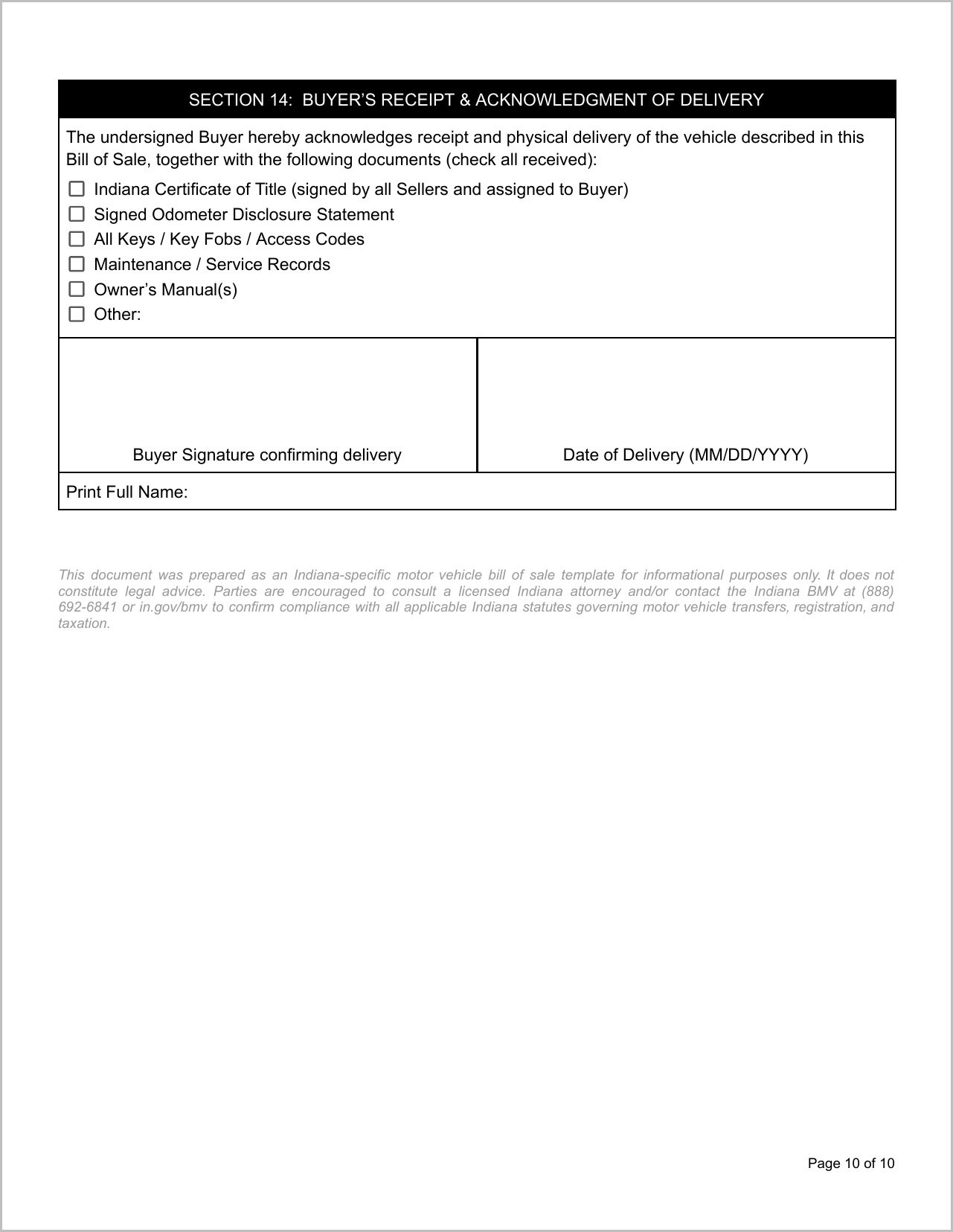
This template opens in Google Docs. Click Use Template to save a copy to your Drive, fill it out digitally, or print and complete by hand.
How to Fill Out the Template
Enter the seller’s name exactly as it appears on the Certificate of Title. Enter the buyer’s name exactly as they want it on the new title.
In Section 3, copy the VIN character by character from the dashboard plate and the title. Enter the full agreed purchase price in Section 4.
Both parties sign Section 11. The seller must also complete the odometer disclosure on the title (or on State Form 43230 if required).
For a complete field-by-field walkthrough of every section, see: How to Fill Out a Motor Vehicle Bill of Sale →
How to Transfer a Car Title in Indiana
For the Seller
Complete the title assignment section, including odometer disclosure. Sign the title over to the buyer. Retain a signed copy of this bill of sale for your records.
For the Buyer
Within 45 days of purchase, visit an Indiana BMV branch or BMV Connect kiosk with the signed title, State Form 205, this bill of sale, odometer disclosure, proof of insurance, valid Indiana ID, and payment for title fees and applicable sales tax.
Lost Title
Apply for a duplicate title at any Indiana BMV branch or at myBMV.com before proceeding with the sale. Contact the Indiana BMV at in.gov/bmv or (888) 692-6841.
Frequently Asked Questions
45 days from the date of purchase. Penalties apply after 45 days. The buyer can complete the title transfer at any Indiana BMV branch or BMV Connect kiosk, or through MyBMV online for eligible transactions.
Indiana’s BMV requires a bill of sale or purchase order primarily when the Certificate of Title is not available or for out-of-state title transfers. For standard in-state private party sales where the seller has a valid title, the signed title is the primary document. A bill of sale is strongly recommended regardless.
Effective July 1, 2025, Indiana now offers customers the option to have their vehicle titles issued electronically or on paper. For most standard private party sales, the paper title process remains the norm. Contact the Indiana BMV for details on electronic title eligibility.
No. Indiana does not require notarization for a standard private party vehicle bill of sale. Notarization is optional but recommended for high-value sales.
Yes. Indiana charges sales tax on private vehicle purchases. If the buyer paid sales tax in another state, Indiana gives credit for the amount paid — if it is less than Indiana’s rate, the difference is due at time of title transfer. New Indiana residents are not charged sales tax when transferring a title from their prior state.
Yes. Indiana does not require a specific state-issued form for all private party vehicle bill of sale transactions. Any bill of sale with the required information — seller and buyer details, vehicle description, VIN, purchase price, date of sale, and signatures — is acceptable alongside the signed title.
This template and all information on this page are provided for informational purposes only and do not constitute legal advice. Contact the Indiana BMV at in.gov/bmv or (888) 692-6841 to confirm current requirements before completing your transaction.