
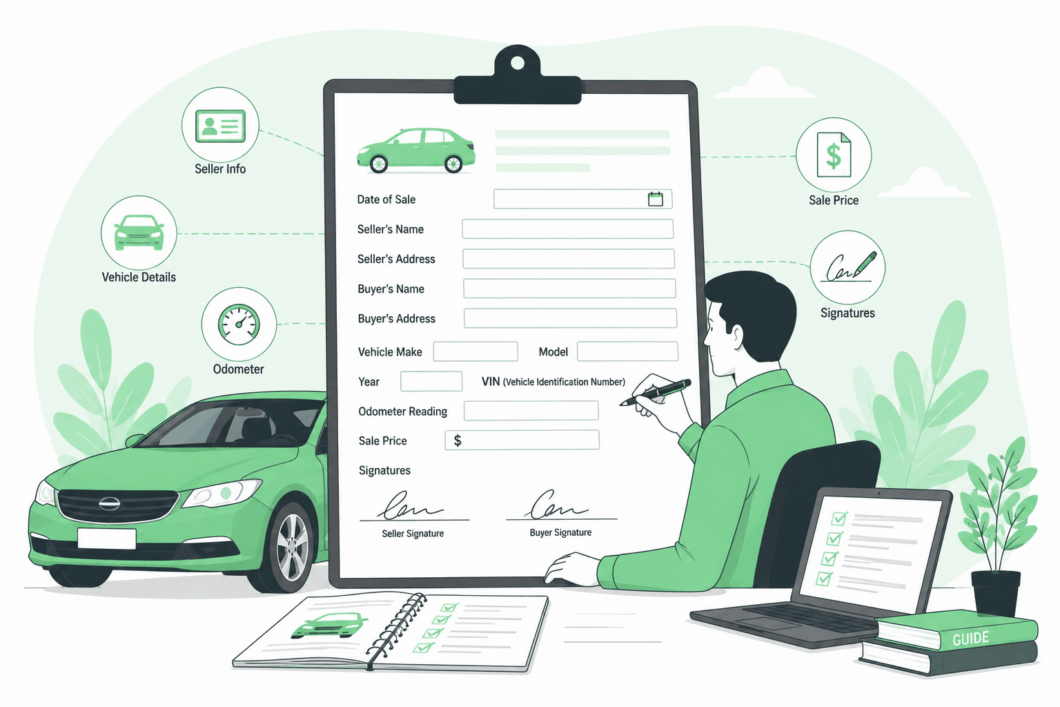
Filling out a motor vehicle bill of sale incorrectly is one of the most common reasons a state DMV rejects a title transfer application.
This guide walks through every field in order — what to write, why it matters, and what to watch out for.
Required fields are marked with an asterisk (*).
Before you start: Read the state-specific notice block at the very top of your template. It contains your state’s exact filing deadline, tax rules, notarization requirements, and any forms your state requires alongside the bill of sale. Those rules override any general guidance in this guide.
The Two Ways to Complete This Form
Online then print: Open the template in Google Docs, make a copy to your Google Drive (File → Make a copy), fill in all fields, and print. Both parties sign the printed copy — in the presence of a notary if your state requires it.
Print blank, fill by hand: Print the template without editing and complete it by hand at the time of signing. Both methods are fully legal. Print two copies and have both parties sign both — one for the seller’s files, one for the buyer’s.
Part 1 — The Basics
These two fields appear at the top of the form before the main sections begin.
Bill of Sale Ref #
Optional. Assign any tracking number you like — for example “BOS-MV-001” — to help you locate this document later. Useful if you keep records of multiple transactions. Leave blank if you do not need it.
Date of Sale *
Enter the date both parties sign the document in MM/DD/YYYY format — for example, 04/15/2025.
This is one of the most important fields on the form. Every state sets a deadline — ranging from 5 days (North Dakota) to 90 days (New Mexico) — by which the buyer must register the vehicle and complete the title transfer. That clock starts on the date of sale recorded here. Get it right, and set a calendar reminder the same day you sign.
Part 2 — Section by Section
Section 1 — Sale Location
This section records where the signing takes place — not where either party lives, and not where the vehicle is stored.
Day, Month, Year *
Write the date in the three separate fields — for example, day “15”, month “April”, year “2025”.
County *
The county where the signing physically occurs. If you are signing at a private residence, use that property’s county. If signing at a bank, dealership, or title office, use the county where that business is located. Examples: “Miami-Dade”, “Harris County”, “Los Angeles”.
State
Pre-printed on your template to match the state-specific version you are using. Do not change it.
Section 2 — The Parties
List every person who is selling and every person who is buying. Incomplete or mismatched party information is one of the most common reasons a state DMV rejects a title transfer application.
Seller Information (Section 2a)
Full Legal Name *
Enter the seller’s name exactly as it appears on the existing Certificate of Title. Do not use nicknames, shortened names, or initials. If the title reads “Robert James Smith,” write “Robert James Smith” — not “Bob Smith” or “R.J. Smith.” Any mismatch between the bill of sale and the title will raise questions at the DMV.
Driver’s License / ID # *
The seller’s driver’s license number or government-issued photo ID number. Many states require this on the title assignment itself — having it on the bill of sale as well is good practice.
State of Issue *
The state that issued the ID — for example “FL” or “TX.”
Mailing Address *
Full street address including city, state, and ZIP code. Use the seller’s current address, not the address on an old registration.
Phone Number and Email
Not required but recommended. Useful if a state agency needs to follow up, or if the buyer needs to reach the seller after the transaction.
Co-Seller Full Legal Name
If the vehicle is jointly owned, list all co-owners here. Every person listed on the title must appear in this section — and must sign Section 11.
Check your title before filling this in. If the title shows “AND” between owner names, every listed owner must sign both the bill of sale and the title assignment. If the title shows “OR,” any one owner may sign alone. This rule applies in virtually every state. A sale completed without all required signatures is legally incomplete and will be rejected at the DMV.
Buyer Information (Section 2b)
Full Legal Name *
Enter the buyer’s name exactly as they want it to appear on the new Certificate of Title. It must match their government-issued ID — including middle names if the buyer uses them on official documents. The state will issue the new title in this exact name.
Driver’s License / ID # *
The buyer’s driver’s license or government-issued photo ID number. Most state DMVs require this when processing the title application.
State of Issue *
The state that issued the buyer’s ID.
Mailing Address *
The buyer’s current mailing address. The state will mail the new Certificate of Title and registration documents to this address. Use a reliable mailing address — a title mailed to the wrong address can take months to resolve.
Co-Buyer Full Legal Name
If more than one person is buying together, list all co-buyers here. All co-buyers must also sign Section 11.
Section 3 — Vehicle Description
This is the most important descriptive section. Every field must match the physical vehicle and its existing paperwork exactly. Discrepancies between the bill of sale and the Certificate of Title are the single most common cause of delayed or rejected title transfer applications.
Year *
The model year of the vehicle as shown on the existing Certificate of Title and the dashboard VIN plate. Note that for some vehicles, the model year printed on the title may differ from the calendar year of manufacture — use what the title says.
Make / Manufacturer *
The brand name of the vehicle — for example “Ford,” “Toyota,” or “Chevrolet.” Use the official manufacturer name as it appears on the existing title, not a colloquial abbreviation.
Model *
The model name as shown on the title — for example “F-150,” “Camry,” or “Silverado 1500.” If the title includes a trim designation (e.g., “XLT” or “Limited”), include it.
Body Style
The vehicle body type — for example “Sedan,” “SUV,” “Pickup Truck,” “Coupe,” or “Minivan.”
Color / Primary Color *
The primary exterior color as it appears on the registration — for example “White,” “Silver,” or “Blue.” If the registration lists a two-tone color, use that.
Vehicle Identification Number (VIN) *
A 17-character alphanumeric code that uniquely identifies the vehicle. Find it in three places: on the dashboard (visible through the windshield on the driver’s side), on the driver’s door jamb sticker, and on the existing Certificate of Title. All three should match.
Verify the VIN character by character against both the physical plate on the vehicle and the title before writing it down. One wrong character will cause the state DMV to reject the application entirely.
Important: The letters I, O, and Q are never used in VINs. If you see what appears to be one of these letters, it is most likely the number 1, 0, or another character. When in doubt, compare against the door jamb sticker, which is typically easier to read.
License Plate Number
The current plate number displayed on the vehicle. In most states, license plates stay with the seller and are not transferred with the vehicle — check the notice block at the top of your template for your state’s rule. A few states (South Dakota, Minnesota) are “plate-with-owner” states where this is especially important.
Title Number
The title number printed on the existing Certificate of Title. This helps the DMV locate the existing record quickly.
Odometer Reading *
The current mileage reading from the instrument cluster at the moment of signing or delivery. Federal law and most state laws require written odometer disclosure for vehicles under 10 model years old with a GVWR of 16,000 lbs. or less. For vehicles with a model year of 2011 or newer, this requirement extends to 20 model years. Read the actual odometer — do not estimate. Some states require the disclosure on the title itself in addition to the bill of sale; check your notice block.
Tip: If the mileage seems low for the age of the vehicle, ask the seller for supporting documentation — service records, inspection stickers, or prior registration documents. Odometer fraud is a federal crime, but it does happen in private sales.
Section 4 — Purchase Price
State agencies use the purchase price to calculate sales tax, use tax, or excise tax at registration. The figure must be accurate. Deliberately understating the price is a criminal offense in most states, and state agencies routinely cross-check declared prices against NADA and Kelley Blue Book market values. If the declared price is significantly below market value, many states will assess tax on the higher market value regardless — and some require a notarized affidavit to explain the difference.
Purchase Price *
The total agreed sale price for the vehicle. Write the full amount. Do not subtract trade-in values unless your state specifically permits it.
Method of Payment
Check the applicable box: Cash, Personal Check, Electronic Transfer, Financing / Promissory Note, Trade-In plus Cash, or Gift.
Do not hand over the signed title or vehicle keys until you have received cleared funds. If the buyer pays by personal check, wait for the check to fully clear before delivering the signed title and the vehicle.
Sales Tax Status
Indicate whether sales or use tax has been collected, will be paid at registration, is exempt, or was already paid to another state. The correct answer depends entirely on your state — refer to the notice block. Some states collect tax at the DMV or county office at the time of title transfer. Others expect the buyer to bring proof of payment. A few states — Montana, New Hampshire, Oregon, and Delaware — have no state sales tax on vehicle purchases.
Section 5 — Odometer Disclosure
Federal law (49 U.S.C. §32705) and state laws require a written odometer disclosure for most motor vehicles. This section creates a legally binding record of the vehicle’s mileage at the time of transfer. Providing a false odometer statement is a federal crime.
Current Odometer Reading *
Enter the exact mileage shown on the odometer at the time of sale. Read it from the instrument cluster at the moment of signing or at delivery — whichever is more accurate and closer in time to the actual transfer.
Accuracy Checkbox *
Check one of three options:
- Actual — The mileage shown is accurate and reflects the true accumulated mileage on the vehicle.
- Not Actual — The odometer reading does not reflect true mileage due to a rollback, replacement, or known malfunction. Describe what is known — when the meter was replaced, what it read at replacement, etc.
- Exceeds Mechanical Limits — The odometer has rolled over its maximum reading and the true total mileage is unknown.
For buyers: High mileage is not necessarily a dealbreaker, but undisclosed high mileage is a red flag. If the “Not Actual” box is checked, ask for as much documentation as the seller can provide before proceeding.
Section 6 — Title, Liens and Encumbrances
The seller makes legally binding warranties in this section. Read each one carefully before signing.
Legal Title Warranty
The seller certifies they hold clear, unencumbered legal title to the vehicle and have the full right to sell it. If you are selling a vehicle that is not yet titled in your name, you cannot legally complete this sale until the title has been transferred into your name first.
Lien-Free Warranty
The seller certifies there are no outstanding loans, security interests, or other encumbrances on the vehicle — except anything specifically disclosed in the Lien Disclosure field below.
Lien Disclosure
If any liens exist, disclose the lienholder’s full name and address here. A written lien release from the lender is required before the title can transfer cleanly. Many states use Electronic Lien and Title (ELT) systems — if your state uses ELT, the lienholder must release the lien electronically before a paper title can be issued for transfer.
For buyers: Never complete a vehicle purchase without confirming lien status. Ask the seller to show you the title — if a lienholder’s name appears on the front, the lien has not been released. You can also run a title history check through your state’s DMV. If a lien exists, require either a written lien release letter from the lender at closing, or use an escrow arrangement that pays the lender directly from the sale proceeds.
Section 7 — Condition and Warranties
7a — Condition of Vehicle
AS-IS / WHERE-IS
The buyer accepts the vehicle in its current condition with all faults known and unknown, and waives the right to demand repairs, replacements, or refunds after signing. This is the standard choice for private vehicle sales in every state.
Selecting AS-IS does not protect the seller from liability for defects they knew about and deliberately concealed. Intentional concealment of known defects is fraudulent misrepresentation and can expose the seller to civil and criminal liability regardless of the AS-IS designation.
Limited Warranty
If the seller is offering any specific warranty, describe the exact scope, duration, and exclusions precisely. Vague warranty language — “runs great,” “mechanically sound” — is one of the leading sources of post-sale disputes and can be interpreted against the seller in court. Example of a specific warranty: “Seller warrants the engine and transmission for 30 days or 1,000 miles from the date of delivery, whichever comes first, against defects that existed at the time of sale, excluding wear items.”
7b — Known Defects and Material Disclosures
Even in an AS-IS sale, the seller has a legal obligation to disclose all known material defects — meaning any condition a reasonable buyer would consider important in deciding whether to purchase and at what price. Failing to disclose known defects is fraudulent misrepresentation in virtually every US state.
Prior Structural or Accident Damage
Check Yes if the vehicle has ever sustained significant structural damage, flooding, fire, or a major collision that required frame or unibody repair. Describe the incident specifically: when it occurred, what was damaged, who repaired it, and whether an insurance claim was filed.
Known Defect Fields
List each known defect individually and specifically. Vague entries like “needs work” are not adequate. Specific examples:
- “Check engine light on — P0420 code (catalyst efficiency below threshold) — cause not repaired”
- “Transmission shudders on acceleration between 30–45 mph — cause unknown”
- “Driver’s side window regulator replaced March 2024 — working correctly since”
- “Minor surface rust on rear wheel wells — no structural involvement”
- “AC compressor not functional”
Attach an addendum if you need more space.
For buyers: For any vehicle over $10,000, or any vehicle you intend to use as a primary driver, consider an independent pre-purchase inspection by a licensed mechanic before signing. A $100–$200 inspection can surface issues that save thousands in repair costs and gives you documented leverage to renegotiate or walk away.
Section 8 — Delivery, Documents and Keys
Delivery Date *
The date the buyer takes physical possession of the vehicle. This is often the same as the sale date, but can be a future date if delivery is delayed — for example, if the seller needs a few days to gather documents or move the vehicle.
Delivery Location *
The specific address or location where the handover takes place — for example “1234 Main Street, Austin, TX 78701” or “Parking lot of Chase Bank, 456 Oak Ave, Dallas, TX 75201.” Be specific enough that the location can be identified unambiguously.
Documents and Keys
List every document and key the seller is providing at delivery:
- Signed Certificate of Title (properly assigned on the reverse by all sellers)
- Current vehicle registration card
- All keys and key fobs (note how many)
- Owner’s manual and service records
- Emissions test certificate (if required by your state)
- Safety inspection certificate (if required by your state)
- Any other items agreed upon
Only list what will actually be handed over at delivery. Do not include items you intend to provide later.
For sellers: Do not hand over the signed title or the vehicle keys until you have received full, cleared payment. For buyers: do not release payment until you have the signed title in hand and have confirmed the VIN on the title matches the vehicle in front of you.
Section 9 — Additional Agreed Terms
Use this section for any terms agreed between buyer and seller that are not covered in the printed sections of the template. Leave it blank if there is nothing to add.
Common examples:
- “Seller agrees to a pre-purchase inspection at buyer’s expense prior to delivery.”
- “Sale is contingent upon buyer obtaining financing approval by May 30, 2025.”
- “Seller will replace both front tires with new tires of equivalent specification prior to delivery.”
- “Seller will provide all available service records and factory documentation at delivery.”
- “Buyer agrees to take physical delivery no later than June 7, 2025.”
If you add terms here, be specific. Vague terms — “seller will fix any issues before delivery” — create disputes. Specific terms — “seller will repair the non-functional air conditioning prior to delivery at seller’s expense” — are enforceable.
Section 10 — General Legal Provisions
Standard legal clauses that apply automatically to the transaction. You do not need to fill anything in here. Key provisions include:
- Governing Law — The laws of the state named in the template govern this agreement and any disputes arising from it.
- Entire Agreement — This document supersedes all prior verbal discussions, text messages, and informal understandings between the parties. What is written here is what was agreed.
- Severability — If any individual clause is found to be unenforceable, the rest of the document remains in effect.
- Electronic Signatures — Digital and electronic signatures are valid and legally binding under your state’s electronic transactions law.
- Time is of the Essence — All dates and deadlines in this document — particularly the state filing deadline — must be strictly observed.
Section 11 — Acknowledgment and Signatures
By signing, each party certifies under penalty of perjury that all information provided in the document is accurate and complete to the best of their knowledge.
Seller Signature *
Sign in ink. The signature should match the Full Legal Name listed in Section 2a. If multiple sellers are listed, every one of them must sign here.
Date *
The date the seller signs. Should match the Date of Sale at the top of the form.
Print Full Legal Name *
Print the seller’s full legal name in block letters. This field is for printing, not signing.
Co-Seller Signature
Required if a co-owner is listed in Section 2a. Both signatures are needed before the form is complete.
Buyer Signature *
The buyer signs here to acknowledge they have read and accept all terms of the sale.
Co-Buyer Signature
Required if a co-buyer is listed in Section 2b.
Sign together where possible. Signing in each other’s physical presence eliminates questions about whether both parties agreed to the same document. If your state requires the title assignment to be notarized — Kentucky, Louisiana, Mississippi, New Jersey, North Carolina, North Dakota, Ohio, Oklahoma, and Wyoming — arrange for notarization at this same signing session so everything is completed in one visit.
Section 12 — Witnesses (Optional)
Most states do not require witnesses for a motor vehicle bill of sale, but having one or two independent witnesses adds a meaningful layer of legal protection — particularly for high-value transactions. A witness cannot be the buyer, the seller, or any other party to the transaction. A witness who has any financial interest in the sale is not an impartial witness.
Witness Signature
An independent adult who was physically present at the signing.
Print Full Legal Name
The witness’s name printed in block letters.
Date
The date the witness signs — should be the same date as the buyer and seller.
Mailing Address
The witness’s current address, in case they need to be contacted at a later date.
Section 13 — Notary Acknowledgment
Notarization requirements vary significantly by state. In the following states, notarization of the title assignment and/or the bill of sale is legally required — not optional:
| State | What Must Be Notarized |
|---|---|
| Kentucky | Seller’s signature on Certificate of Title |
| Louisiana | Seller must sign title before a notary; separate notarized bill of sale if price not on title |
| Mississippi | Seller’s signature on Certificate of Title |
| New Jersey | Bill of Sale |
| North Carolina | Seller’s title signature and Form MVR-1 (Title Application) |
| North Dakota | Bill of Sale Form SFN 2888 (both buyer and seller must sign before a notary) |
| Ohio | Seller’s signature on Certificate of Title or Form BMV 3770 |
| Oklahoma | Title assignment (paper) or Form 718 (electronic title) |
| West Virginia | Bill of sale when declared price is below 50% of NADA Clean Loan Book value |
| Wyoming | Seller’s title signature; buyer’s Application Form MV-300A |
In all other states, notarization is optional but recommended for sales above $5,000.
State of / County of *
Where the notarization takes place. This can differ from the state where the vehicle is registered.
Date *
The date the notary witnesses the signing.
Notary Signature and Seal *
The notary signs and affixes their official seal or ink stamp. Both the signature and the seal are required — a notarization without the seal is not valid in most states.
Commission Number and Expiration Date *
Verify the commission is current on the date of signing. An expired notary commission invalidates the entire notarization and will cause the DMV to reject the application.
Where to find a notary: Banks, credit unions, UPS Store locations, libraries, law offices, and most county DMV or clerk offices. If your state permits Remote Online Notarization (RON), you can complete the process by video call without leaving home.
Important for online filers: If you filled out the form in Google Docs and printed it, do not sign it before visiting the notary. Bring the unsigned printed form and sign it in the notary’s presence.
Section 14 — Buyer’s Receipt and Acknowledgment of Delivery
This section serves a different purpose from Section 11. Where Section 11 acknowledges the terms of the sale, Section 14 specifically confirms the physical handover of the vehicle and all associated documents.
Checkboxes
Check only the items that were physically received at delivery:
- Original signed Certificate of Title (properly assigned on the reverse by all sellers)
- Current vehicle registration card
- All keys and key fobs
- Owner’s manual and service records
- Emissions test certificate (where applicable)
- Safety inspection certificate (where applicable)
Do not check an item you expect to receive later. If items are being delivered at a future date, note that in Section 9 under Additional Agreed Terms.
Other
List any additional items received that are not covered by the printed checkboxes — for example “floor mats and cargo liner,” “tow hitch and ball mount,” “original window sticker,” or “extended warranty transfer documents.”
Buyer Signature Confirming Delivery *
This is a separate signature from Section 11. It specifically confirms the physical handover of the vehicle and all listed items on the date shown below.
Date of Delivery *
The actual date the buyer took physical possession of the vehicle. This may differ from the date of sale if delivery was scheduled for a later date.
Part 3 — What to Do After Signing
For the Seller
File your seller notification immediately. Many states require you to notify the DMV or a state portal within a set timeframe after the sale — California within 5 days, Oregon within 10, Wisconsin the same day. This removes your liability for the vehicle and prevents future property tax, registration renewal notices, or toll violations from arriving in your name. Check the notice block for your state’s requirement and deadline.
Keep a permanent copy. Store a signed copy of the bill of sale and a photocopy of the assigned title in your files indefinitely. You may need them years later for tax purposes, liability disputes, or to prove you no longer own the vehicle.
Cancel your insurance on the date of sale — or delivery if later. Do not cancel before delivery, as you remain responsible for the vehicle until it physically leaves your possession.
Remove your license plates before handing over the vehicle in any state where plates stay with the seller. Leaving your plates on a vehicle you have sold can result in liability for toll violations, parking fines, and even traffic citations generated by the new owner.
File any state-required forms. Many states have a separate Notice of Sale, Transfer Notification, or Release of Liability form. Florida’s Form HSMV 82050, Texas’s Vehicle Transfer Notification, California’s Notice of Transfer — check the notice block and complete these within the required timeframe.
For the Buyer
Register the vehicle within your state’s deadline. Late penalties vary from a few dollars to criminal misdemeanor charges depending on the state. Note the deadline from the notice block and treat it as a hard deadline, not a suggestion.
Do not drive the vehicle on public roads without valid registration and insurance. Some states allow a short grace period on the basis of a bill of sale alone — others do not. Check your notice block.
Get insurance before taking delivery. Most states require proof of insurance before they will issue a title or registration. Some require the insurance card to list the specific vehicle’s VIN.
Keep a copy of the bill of sale in the vehicle until you receive your new title and registration cards in the mail. If you are stopped and have not yet completed registration, this is your primary proof of ownership.
Retain the lien release letter permanently if the seller paid off a loan before the sale. You will need this document if you ever sell the vehicle in the future.
Part 4 — Common Mistakes to Avoid
VIN does not match the title.
Verify the VIN character by character against the dashboard plate AND the existing title. One transposed character causes the DMV to reject the application entirely. Remember: I, O, and Q are never used in VINs.
Seller is not the titled owner.
The person signing as seller must be the person listed on the current Certificate of Title. If the title is in a deceased owner’s name, a former partner’s name, or anyone else’s name, that must be legally corrected before the sale can proceed. Never buy a vehicle from someone who cannot produce a title in their own name.
Outstanding lien not disclosed.
Selling a vehicle with an undisclosed lien is fraud in most states. The buyer could end up with a vehicle a lender repossesses. Always confirm lien status before buying. Require a written lien release from the lender at closing if a lien exists.
Sale price is understated.
State agencies cross-check prices against NADA and Kelley Blue Book. If the declared price is below the state’s threshold — often 50–80% of market value — many states will assess tax on the higher market value regardless, and some require a notarized affidavit to explain the discrepancy. Write the actual agreed price.
Co-owner signature is missing.
If the title shows “AND” between owner names, every listed owner must sign both the bill of sale and the title assignment. The DMV will reject a title assignment that is missing a required signature.
Title assignment left partially blank.
Fill in every required field on the title assignment before signing it over. An incomplete assignment is invalid and can be exploited. Write N/A in fields that do not apply — do not leave them blank.
Buyer waits too long to register.
Deadlines range from 5 days (North Dakota) to 90 days (Utah). In Washington state, failure to apply within 45 days is a criminal misdemeanor. Set a calendar reminder the day you sign.
Notarization skipped when required.
In Ohio, Kentucky, Louisiana, Mississippi, New Jersey, North Carolina, North Dakota, Oklahoma, and Wyoming, notarization is a legal requirement — not a suggestion. A bill of sale or title assignment that should have been notarized but was not will be rejected by the DMV, and the parties will have to meet again to redo the paperwork.
License plates not removed.
In most states, license plates belong to the seller and must be physically removed before the buyer drives the vehicle away. Plates left on a sold vehicle have been used in toll evasion, traffic violations, and more serious crimes that are then traced back to the former owner.
Pre-signing before the notary.
If your state requires notarization and you filled out the form online, do not sign the printed copy before your notary appointment. The entire purpose of notarization is to verify that the signatures were made in the notary’s presence. A pre-signed document cannot be properly notarized.
This guide is for informational purposes only and does not constitute legal advice. Motor vehicle transfer laws vary by state and are subject to change. For complex transactions — vehicles with title defects, cross-state transfers, estate sales, or business-owned vehicles — consult a licensed attorney in your state before proceeding.