
Selling or buying a boat in Florida involves more paperwork than most people expect.
Florida requires both the seller and the buyer to file specific forms with the county Tax Collector’s office within 30 days of the sale.
Notarization is required in several common situations. And if the sale includes an outboard motor, how you structure the bill of sale directly affects how much sales tax the buyer pays at the title office.
This page gives you a free, professionally drafted Florida boat bill of sale template — covering all 14 sections required for a complete and legally sound transaction under Florida law.
Click Get This Template below, preview it in a new tab, then click Use Template to save a copy to your Google Drive. Fill it out digitally or print and complete by hand.
Important: This template is a strong starting point, but Florida requirements can vary by county. Before using this template in a live transaction, consider having a licensed Florida attorney or your county Tax Collector’s office review it.
Table of Contents
- What Is a Florida Boat Bill of Sale?
- Is a Boat Bill of Sale Required in Florida?
- Florida-Specific Requirements You Must Know
- Free Florida Boat Bill of Sale Template
- What the Template Covers
- How to Fill Out a Florida Boat Bill of Sale (Step by Step)
- How to Transfer a Boat Title in Florida
- Frequently Asked Questions
What Is a Florida Boat Bill of Sale?
A Florida boat bill of sale is a legal document that records the transfer of ownership of a vessel — and any associated motor, trailer, or accessories — from a seller to a buyer.
It establishes the agreed purchase price, identifies both parties, describes the vessel in full, and documents the terms of the transaction including payment method, condition, and any known defects.
In Florida, a bill of sale is used alongside the Certificate of Title — it does not replace the title, but it is required by the county Tax Collector’s office as supporting proof of the transaction when the buyer applies for a new title in their name.
For vessels coming from states that do not issue titles, the bill of sale serves as the primary proof of ownership for Florida title purposes.
Is a Boat Bill of Sale Required in Florida?
Yes — in most Florida vessel transactions, a bill of sale is either required or strongly recommended.
It is required when the vessel is being transferred from a state that does not issue vessel titles, since the bill of sale combined with the out-of-state registration is the only proof of ownership available. It is also required when the Florida Certificate of Title contains any cross-outs, alterations, or white-out — in which case a notarized bill of sale must accompany the title transfer application.
It is strongly recommended for all private sales, even when a clean Florida title is available, because it documents the purchase price (which determines sales tax), protects both parties in the event of a dispute, and limits the seller’s civil liability once filed with the state.
For dealer sales, the dealership handles the paperwork. This template is designed for private (casual) sales between individuals.
Florida-Specific Requirements You Must Know
1. Seller: File Form HSMV 82050 Within 30 Days
After the sale, the seller must complete the Notice of Sale section on the back of the Florida Certificate of Title, or file Form HSMV 82050 (Notice of Sale and/or Bill of Sale) with their county Tax Collector’s office within 30 days.
This removes the seller from record as the owner and limits civil liability for anything that happens with the vessel after the sale date.
2. Buyer: File Form HSMV 82040 Within 30 Days
The buyer must apply for a new Florida Certificate of Title by filing Form HSMV 82040 (Application for Certificate of Title with/without Registration) at their county Tax Collector’s office or license plate agency within 30 days of the sale.
Florida sales tax — 6% state rate plus any applicable county discretionary surtax — is due at this time based on the taxable purchase price.
3. Notarization
Florida requires notarization of the bill of sale in three specific situations: to qualify for the outboard motor sales tax exemption, to transfer ownership when the vessel comes from a non-title state, and when the Florida Certificate of Title contains any cross-outs or alterations.
Even outside these situations, notarization is strongly recommended for all Florida vessel transactions.
4. Outboard Motor Sales Tax Exemption
This is one of the most important and least-known rules for Florida private boat sales. In a casual (non-dealer) sale, the outboard motor may be exempt from Florida sales tax if its price is separately itemized on the bill of sale AND the bill of sale is notarized.
This is authorized under F.S. §212.05 and Fla. Admin. Code R. 12A-1.007.
This exemption does not apply to inboard or I/O motors, trailers, or any dealer sales. For a boat with expensive outboard engines, separately itemizing the motor price on a notarized bill of sale can save the buyer thousands of dollars in sales tax.
5. Florida Sales Tax Rate
The Florida state sales tax rate on vessel purchases is 6%, plus any applicable county discretionary surtax. Several counties charge an additional 0.5% to 1.5% on top of the state rate.
Sales tax is calculated on the taxable purchase price and paid at the county Tax Collector’s office when the buyer files for the new title.
6. Trailer Titling Threshold
Boat trailers under 2,000 lbs are not required to be titled in Florida — they are registered only. Trailers weighing 2,000 lbs or more must be titled. If the trailer’s empty weight is unknown, a certified weight slip is required at the Tax Collector’s office.
7. Joint Ownership Signing Rules
If the vessel title lists multiple owners joined by “AND,” all owners must sign the bill of sale. If joined by “OR,” only one owner’s signature is required.
Free Florida Boat Bill of Sale Template
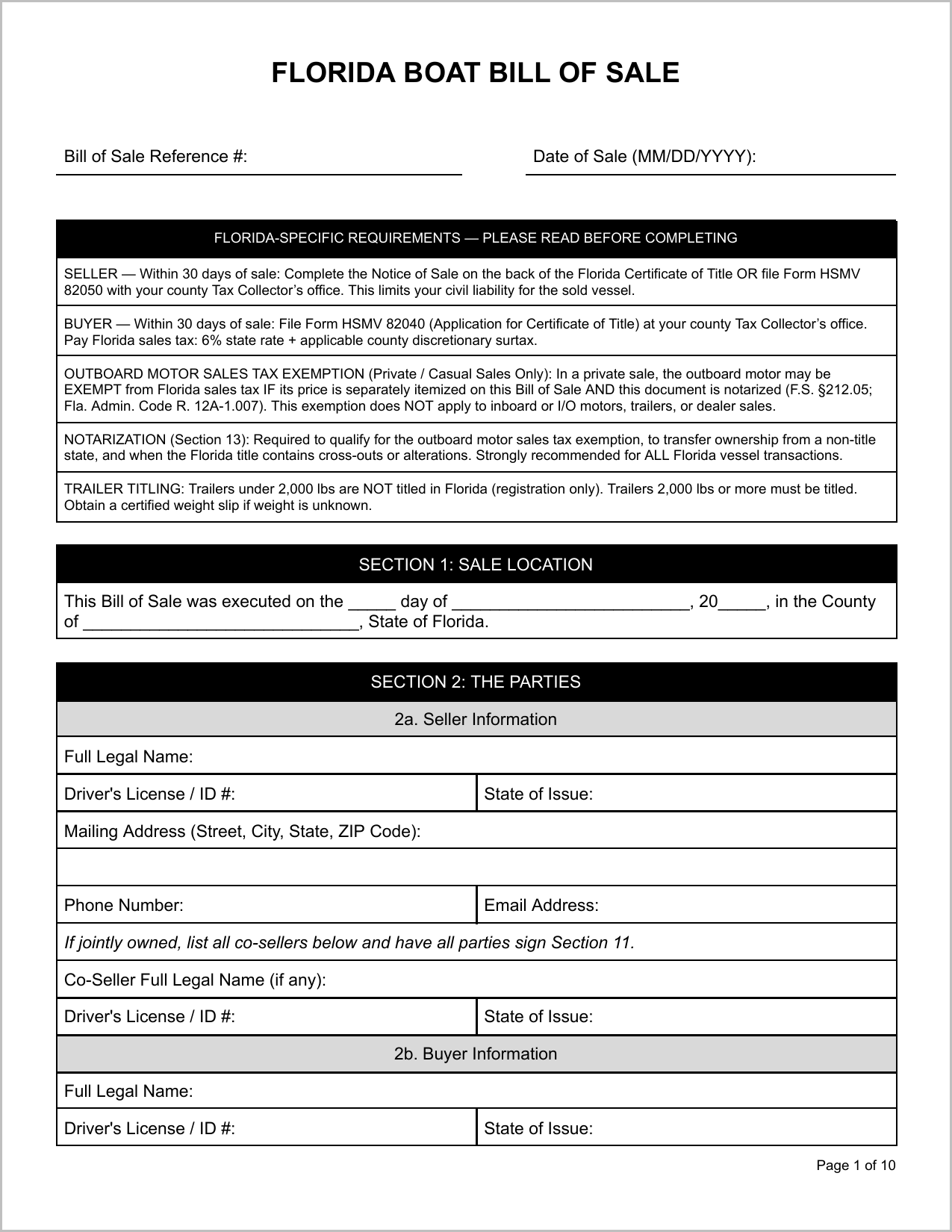
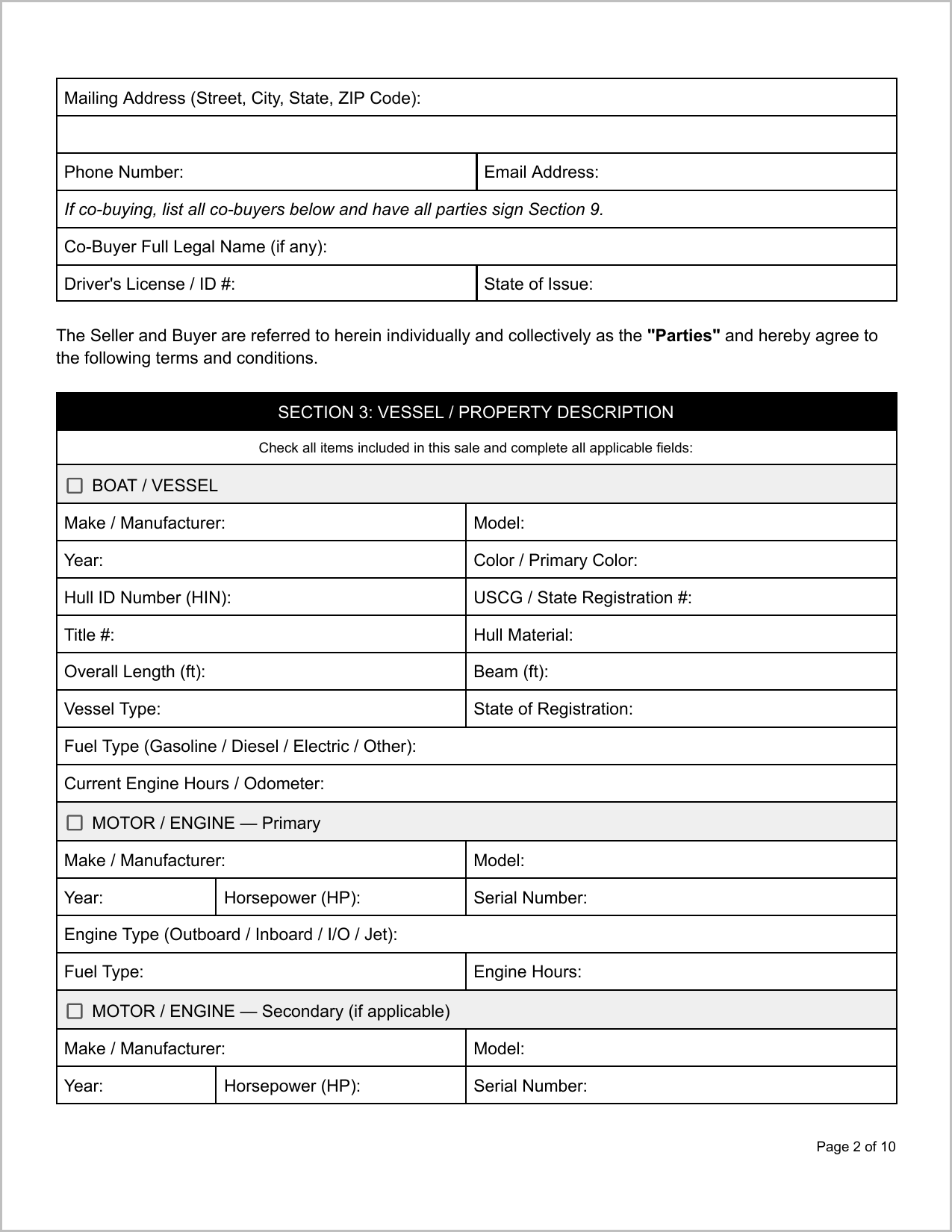
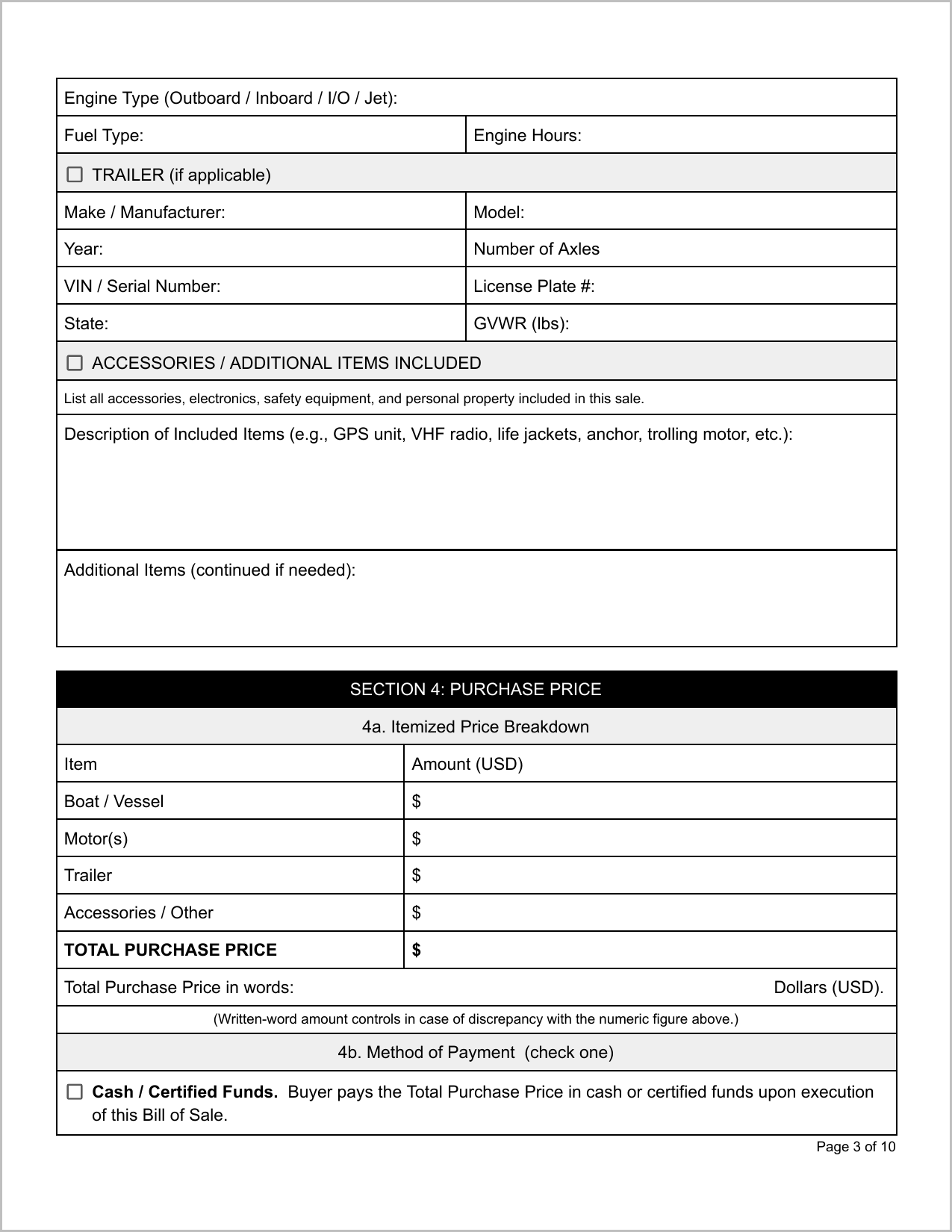
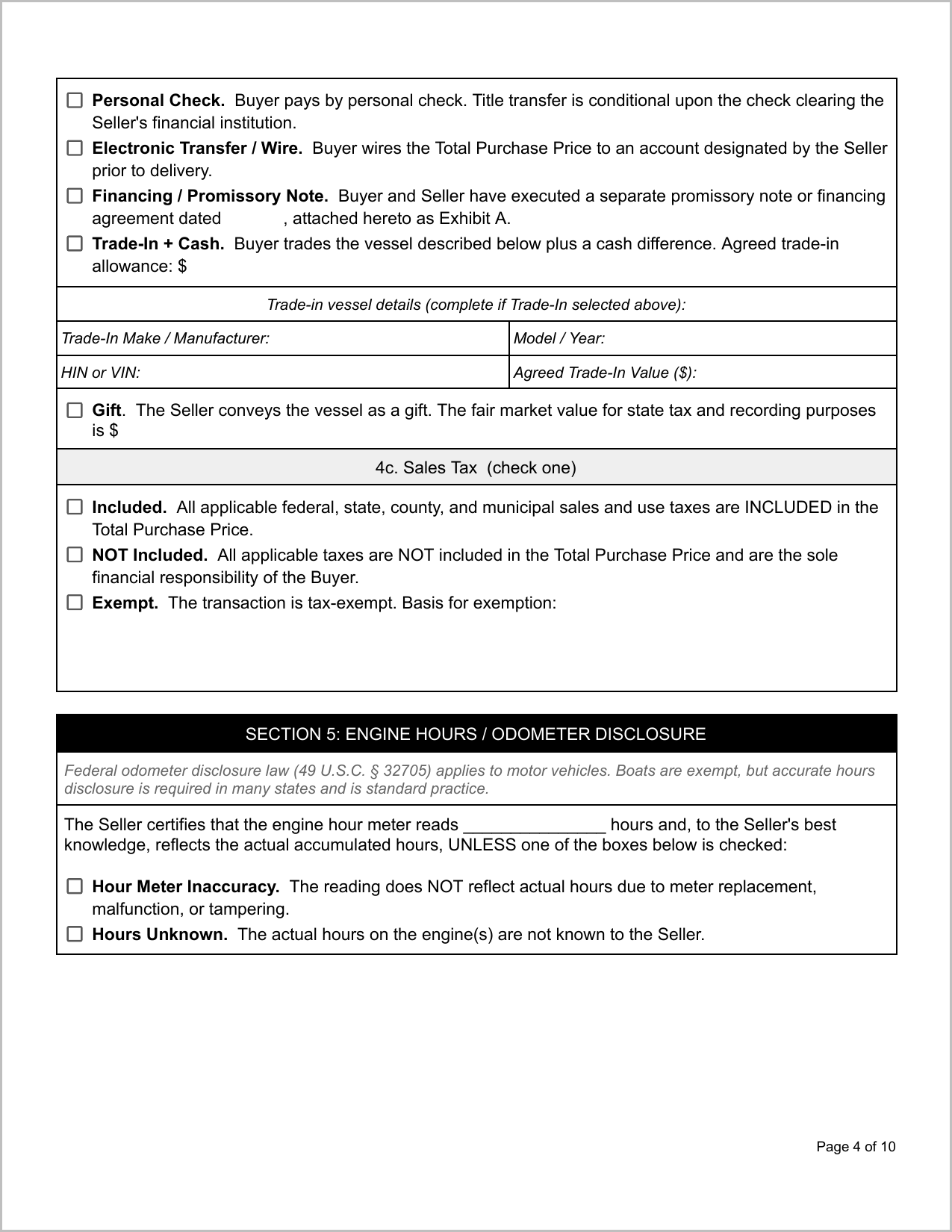
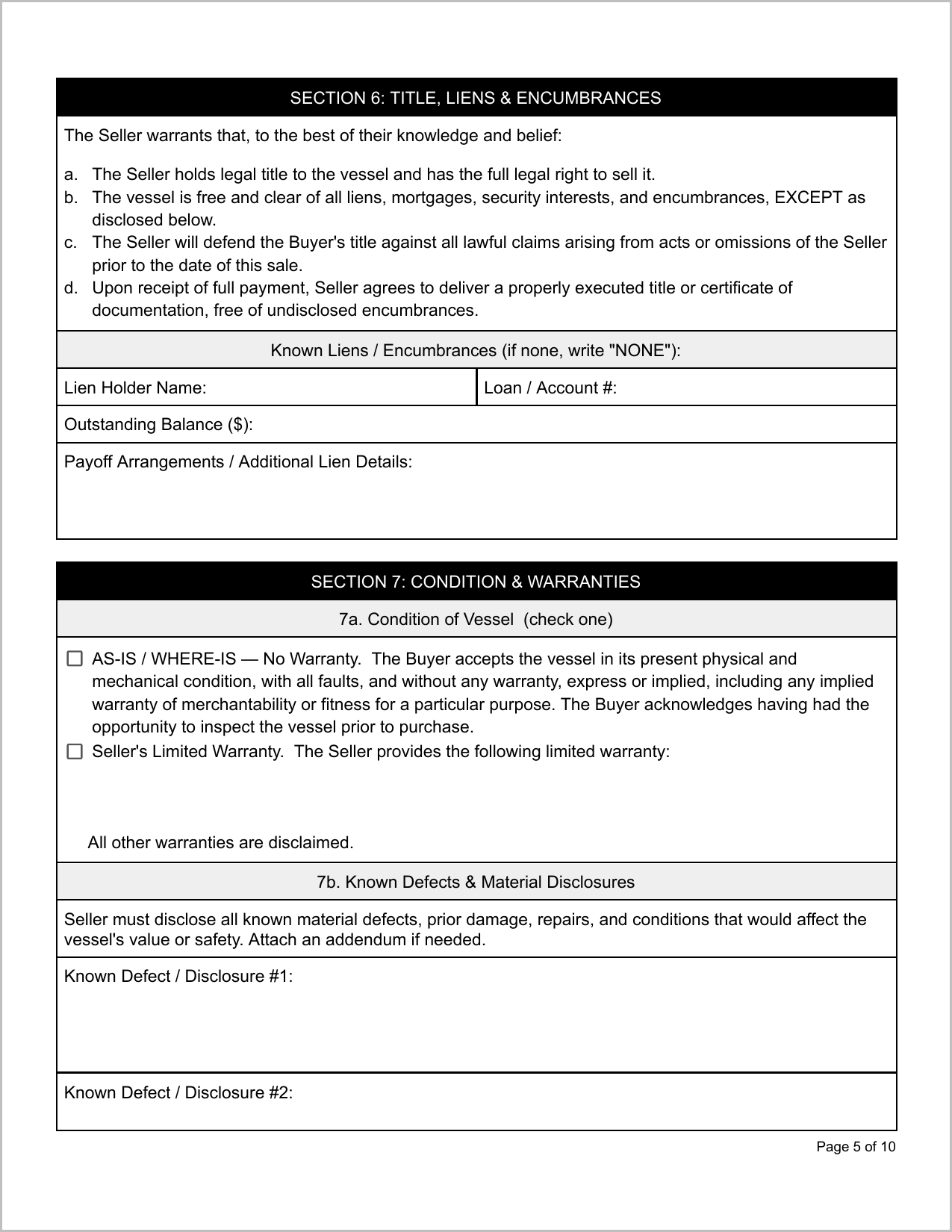
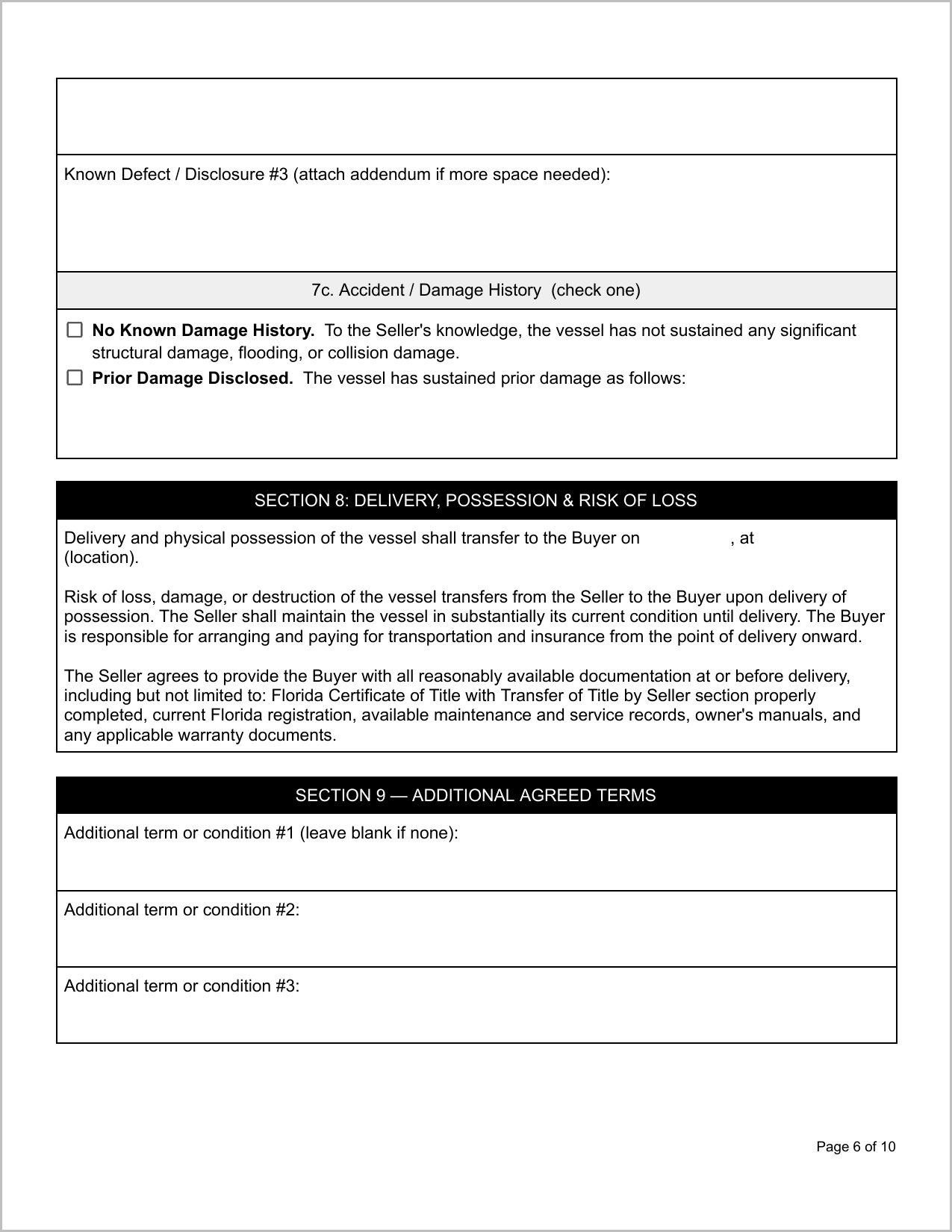
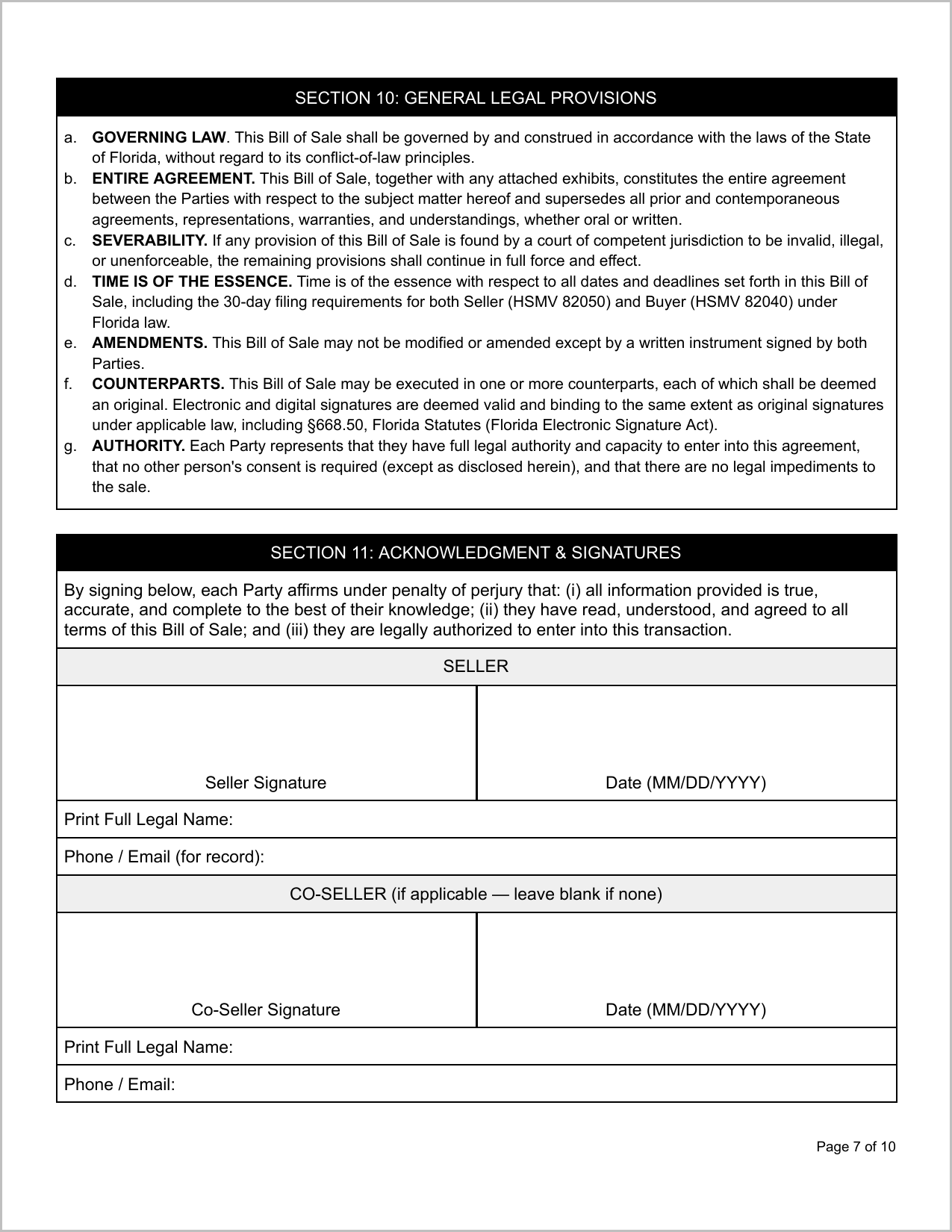
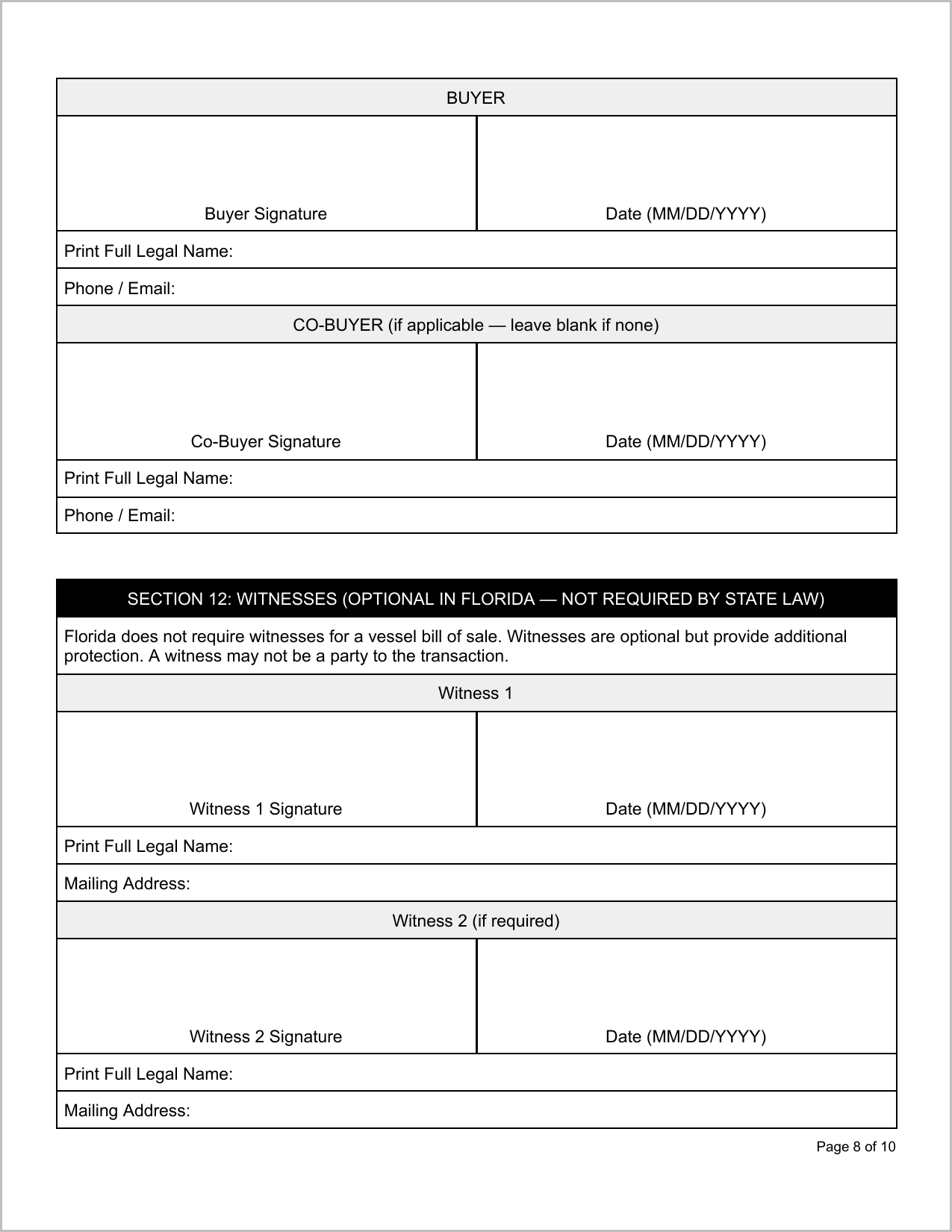
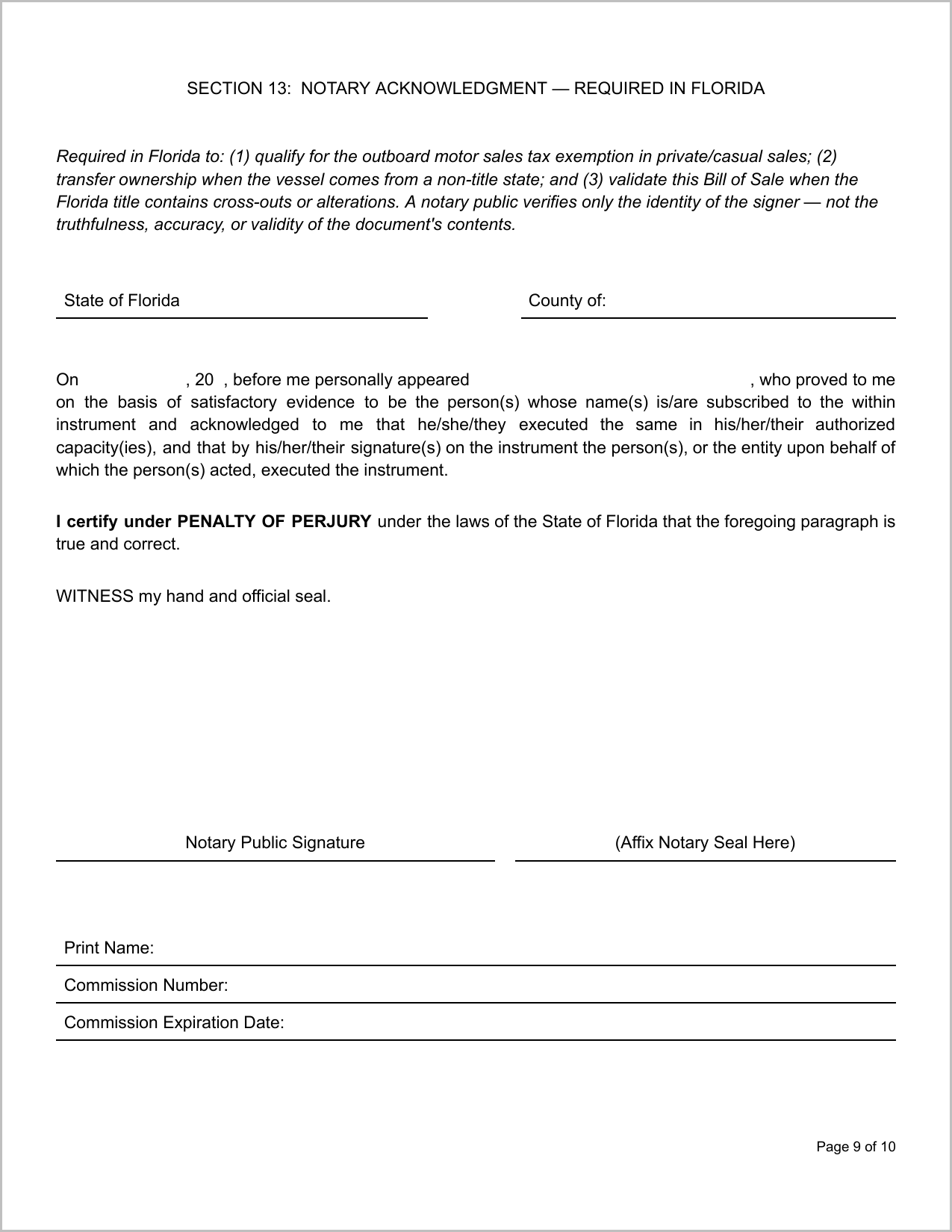
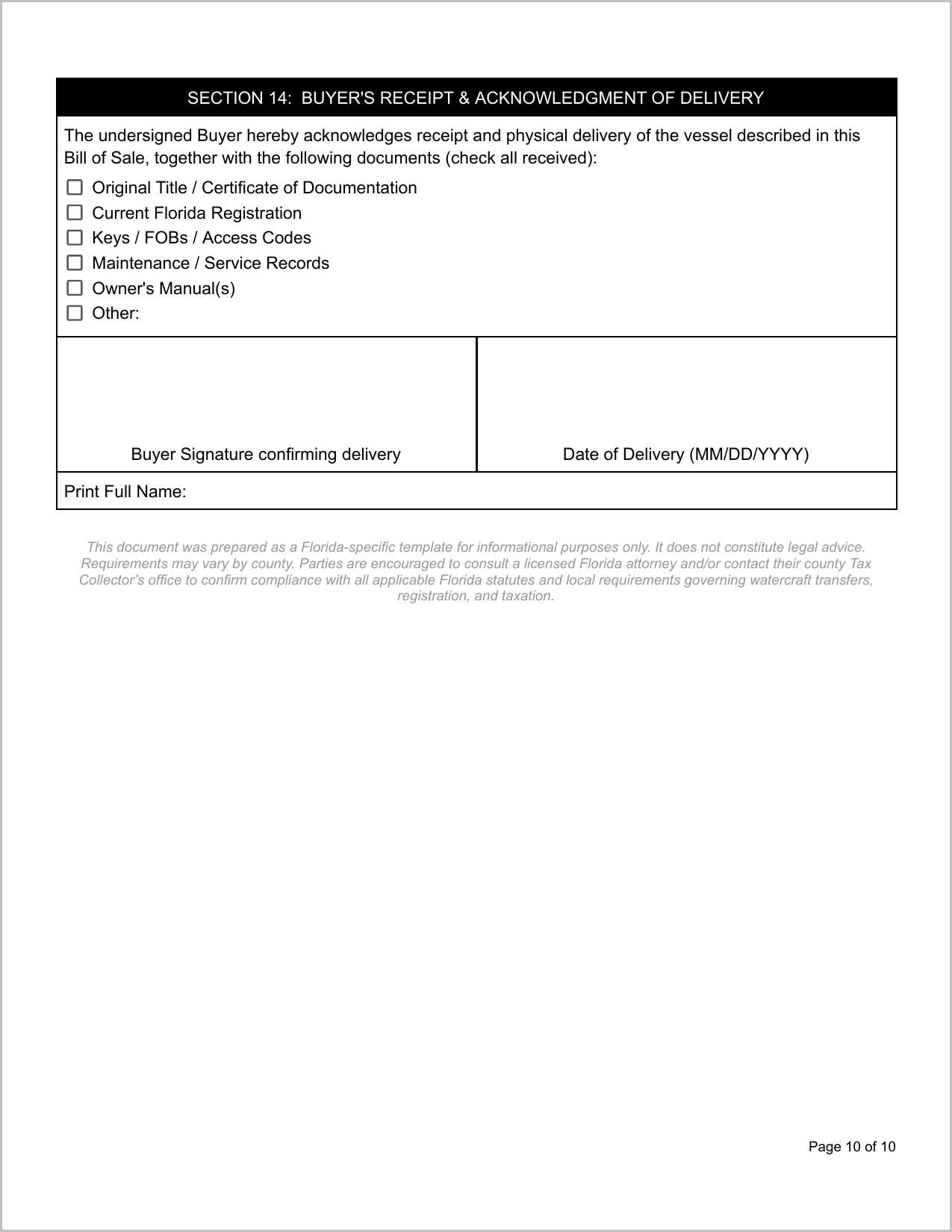
This template covers all 14 sections required for a complete Florida vessel transaction — from vessel description and purchase price through to notary acknowledgment and buyer’s receipt of delivery.
It is formatted for Google Docs so you can fill it out digitally or print and complete by hand.
Click the button below to preview the template in a new tab, then click Use Template to save a copy to your Google Drive.
What the Template Covers
This is not a basic two-page form. The template is organized into 14 sections and covers everything required for a complete Florida vessel transaction.
1. Section 1 — Sale Location
Records the date, county, and state — hardcoded as Florida — where the bill of sale is executed.
2. Section 2 — The Parties
Full legal names, driver’s license or ID numbers, mailing addresses, phone numbers, and email addresses for both seller and buyer — including co-seller and co-buyer fields. Florida’s AND/OR signing rule for joint-ownership titles is noted directly in this section.
3. Section 3 — Vessel / Property Description
Separate subsections for the boat (HIN, FL registration number, title number, hull material, length, beam, vessel type, propulsion type, fuel type, engine hours, use of vessel), primary and secondary motors (make, model, year, horsepower, serial number, engine type), trailer (VIN, license plate, empty weight, number of axles), and accessories. All fields required by Florida HSMV for a complete vessel description are included.
4. Section 4 — Purchase Price
Itemized price breakdown table that separates the boat hull, outboard motor(s), inboard/I/O motor(s), trailer, and accessories — critical for the Florida outboard motor sales tax exemption.
Includes total purchase price, written-word amount for fraud prevention, method of payment options, and a Florida-specific sales tax status section covering not-yet-paid, previously paid to a dealer, paid in another state, and exempt scenarios.
5. Section 5 — Engine Hours / Odometer Disclosure
Seller certification of current engine hours with checkboxes for hour meter inaccuracy or unknown hours.
6. Section 6 — Title, Liens & Encumbrances
Four-point title warranty from the seller, lien disclosure fields, and a Florida-specific note about lien holder title possession rules — including the requirement for a lien holder letter before transfer when payments are outstanding.
7. Section 7 — Condition & Warranties
AS-IS / WHERE-IS checkbox or seller’s limited warranty option, three known defect disclosure fields with space for written descriptions, and accident/damage history checkboxes.
8. Section 8 — Delivery, Possession & Risk of Loss
Delivery date and location fields, risk of loss transfer language, and seller’s obligation to provide the Florida Certificate of Title with the Transfer of Title by Seller section properly completed at the time of delivery.
9. Sections 9 & 10 — Additional Terms & General Legal Provisions
Three open fields for any custom agreed terms, plus seven standard legal provisions: governing law (Florida), entire agreement, severability, time is of the essence (referencing Florida’s 30-day HSMV filing deadlines), amendments, counterparts and electronic signatures under §668.50 Florida Statutes, and authority.
10. Sections 11 & 12 — Signatures & Witnesses
Signature blocks for seller, co-seller, buyer, and co-buyer, each with a perjury affirmation. The witness section is clearly marked as optional in Florida, with a note that witnesses are not required by state law.
11. Section 13 — Notary Acknowledgment
Full Florida notary acknowledgment block with perjury certification language, Florida notary seal affixation field, and Florida Commission number and expiration date fields. Includes a plain-language explanation of the three situations where notarization is required in Florida.
12. Section 14 — Buyer’s Receipt & Acknowledgment of Delivery
Buyer checklist confirming receipt of the Florida Certificate of Title, current Florida registration, keys, maintenance records, owner’s manuals, and any other included items. Includes a buyer signature line confirming physical delivery of the vessel.
How to Fill Out a Florida Boat Bill of Sale (Step by Step)
1. Step 1 — Verify the Title and Check for Liens
Before filling out anything, verify the seller is the legal owner by examining the Florida Certificate of Title. Confirm there are no outstanding liens — if a lender holds the title, it must be released before the transfer can proceed. You can check vessel lien records through the Florida DHSMV or your county Tax Collector’s office.
2. Step 2 — Decide Whether to Separately Itemize the Outboard Motor
If the sale includes an outboard motor, both parties should decide whether to separately itemize the motor price in Section 4. If yes, and the bill of sale is notarized, the buyer may pay Florida sales tax on the hull price only — not the motor. Make this decision before completing the price section.
3. Step 3 — Complete Every Field
Fill in every section. Use “N/A” for fields that do not apply — never leave fields blank, as blank fields create ambiguity. For Section 3, have the Florida title and registration documents in front of you so you can copy the HIN, registration number, and title number accurately.
4. Step 4 — Write the Purchase Price in Words
Section 4 requires both the numeric price and the written-word amount. The written-word amount controls in the event of any discrepancy. Do not skip this — it is standard practice in Florida legal documents and adds an important layer of fraud protection.
5. Step 5 — Both Parties Sign
Seller and buyer both sign and date Section 11. If there are co-sellers or co-buyers, all must sign. Keep the Florida joint-ownership signing rules in mind — if the title uses “AND,” both owners must sign.
6. Step 6 — Get It Notarized
If you are separately itemizing the outboard motor, transferring from a non-title state, or the title has any alterations, notarization is required. Even if none of these situations apply, getting it notarized is strongly recommended. Both parties visit a Florida notary public together with valid government-issued ID.
7. Step 7 — Each Party Keeps a Signed Copy
Make at least two signed copies — one for the seller, one for the buyer. The buyer will need the original or a copy when filing Form HSMV 82040 at the Tax Collector’s office.
How to Transfer a Boat Title in Florida
1. What the Seller Must Do
Complete the Transfer of Title by Seller section on the back of the Florida Certificate of Title — including your signature, printed name, selling price, date of sale, and the buyer’s name. Then file Form HSMV 82050 with your county Tax Collector’s office within 30 days to notify the state of the sale and protect yourself from future liability for the vessel.
2. What the Buyer Must Do
Within 30 days of the sale, visit your county Tax Collector’s office or license plate agency and bring: the completed Florida Certificate of Title with the seller’s Transfer of Title section filled out, this signed and notarized bill of sale, a completed Form HSMV 82040, and your valid Florida Driver’s License or ID. Be prepared to pay Florida sales tax and title fees at this appointment.
3. Title Fees
Florida vessel title fees are $5.25 for an electronic title, $7.75 for a paper title, or $11.00 for an expedited title. An additional $1.00 per lien recorded is charged if any liens are being registered. If the vessel was previously registered outside of Florida, an additional $4.00 fee applies.
4. Vessels From Non-Title States
If you are purchasing a vessel from a state that does not issue vessel titles, proof of ownership for Florida title purposes is the current out-of-state registration plus a notarized bill of sale from the person listed on that registration.
Frequently Asked Questions
Does a boat bill of sale need to be notarized in Florida?
Notarization is required in three specific situations: when the outboard motor is separately itemized and you want the sales tax exemption, when the vessel comes from a non-title state, and when the Florida title contains cross-outs or alterations. Outside of these situations it is not strictly required by law, but it is strongly recommended for all private vessel transactions in Florida.
Is a bill of sale the same as a title in Florida?
No. The Florida Certificate of Title is the legal document that establishes ownership of the vessel. The bill of sale is a record of the transaction — it documents what was sold, for how much, and under what terms. Both are needed for a complete title transfer. A bill of sale alone does not transfer legal ownership of a vessel in Florida.
How do I file Form HSMV 82050 in Florida?
Complete the Notice of Sale section on the back of your Florida Certificate of Title and bring it to your county Tax Collector’s office, or complete and submit Form HSMV 82050 directly. This must be done within 30 days of the sale. Filing removes you from civil liability for the vessel from the sale date forward.
Can I sell a boat without a title in Florida?
Florida requires most motorized vessels to be titled. If you have lost your title, you must apply for a duplicate title through the Florida DHSMV before completing the sale. Attempting to sell without a title makes it difficult or impossible for the buyer to register and title the vessel in their own name.
How much is sales tax on a boat in Florida?
Florida sales tax on a vessel purchase is 6% of the taxable purchase price, plus any applicable county discretionary surtax — typically 0.5% to 1.5% depending on the county. In a private sale with a notarized and itemized bill of sale, the outboard motor may be exempt from sales tax. Inboard motors and trailers are always taxable in a private sale.
Do I need witnesses on a boat bill of sale in Florida?
No. Florida does not require witnesses for a vessel bill of sale. The template includes an optional witness section for parties who want additional protection, but it is not required by Florida state law.
What happens if I don’t file HSMV 82050 as the seller?
If you do not notify the state of the sale within 30 days, you remain on record as the vessel’s owner. This means you could be held civilly liable for incidents involving the boat — accidents, unpaid marina fees, citations, or damage — even after you have sold it. Filing HSMV 82050 protects you from this exposure.
Can I use this template for a boat and trailer sold together?
Yes. Section 3 includes a dedicated trailer subsection covering make, model, year, VIN, license plate, number of axles, and empty weight. Section 4 has a separate line item for the trailer price. Keep in mind that trailers under 2,000 lbs are not titled in Florida — registration only — while trailers 2,000 lbs or more require a Florida title.
NOTICE: This template and all information on this page are provided for educational and informational purposes only and do not constitute legal advice. Florida law and county-level requirements can change. Always consult a licensed Florida attorney and/or your county Tax Collector’s office before executing any vessel transaction.